Zjednoczone Królestwo

This page is also available in:

Po długich i złożonych negocjacjach UE i Zjednoczone Królestwo zawarły 24 grudnia 2020 r. umowę o handlu i współpracy. Od 1 stycznia 2021 r. obowiązywała ona tymczasowo, do zakończenia procesu ratyfikacji przez Radę i Parlament Europejski. Umowa ta, podobnie jak inne niedawne umowy o wolnym handlu, zawiera szczegółowe postanowienia dotyczące dialogu ze społeczeństwem obywatelskim. EKES, który jest kluczowym podmiotem tego dialogu, podjął zatem decyzję w sprawie struktury instytucjonalnej mającej wspierać kontakty ze Zjednoczonym Królestwem i jego społeczeństwem obywatelskim (przedsiębiorstwami, związkami zawodowymi i innymi organizacjami), a także w sprawie organu monitorującego umowę o handlu i współpracy.

Nowa struktura, dostosowana w świetle nie tylko zawartej umowy i nowych stosunków między UE a Zjednoczonym Królestwem, ale również ostatnich zmian instytucjonalnych w KE, obejmuje:

  • Komitet Monitorujący UE–Zjednoczone Królestwo jako politycznego następcę grupy monitorującej ds. brexitu – organ EKES-u, w którym możemy określać nasz własny program i nasze priorytety, aby sprostać potrzebom nowej rzeczywistości,
  • wewnętrzną grupę doradczą UE w ramach umowy o handlu i współpracy między UE a Zjednoczonym Królestwem, będącą instytucjonalnym filarem stosunków handlowych między UE a Zjednoczonym Królestwem.

Teraz gdy przyszłe stosunki zostały uregulowane w tak ważnej i kompleksowej umowie o partnerstwie, EKES zobowiązuje się do odgrywania swojej roli w optymalizacji potencjału tej umowy, zwłaszcza w odniesieniu do społeczeństwa obywatelskiego Zjednoczonego Królestwa. Jest zdecydowany utrzymywać bliskie kontakty ze społeczeństwem obywatelskim Zjednoczonego Królestwa po brexicie, zachęcać do dialogu i wymiany oraz włączać organizacje społeczeństwa obywatelskiego w społeczny proces podejmowania decyzji, aby zapewnić ochronę silnych więzi gospodarczych, społecznych i politycznych, które powstały przez ponad pół wieku członkostwa Zjednoczonego Królestwa w UE.

  • In this opinion the EESC: 

    • provides guidance for an ambitious TCA review, recommending integral roles for EU and UK DAGs due to their practical insights and experience of the agreement's impacts;
    • calls for an enhanced regulatory cooperation on non-tariff barriers which will provide the biggest opportunity to improve the bilateral trade relations – closer alignment of regulatory systems reduces frictions and yields considerable benefits;
    • calls for mutual recognition of standards and improved mobility for services to reduce border friction, lower trading costs, and boost fair market access, growth and job creation on both sides;
    • insists on a ‘future-proof TCA’ by incorporating the youth perspective, progressively removing barriers to seizing new opportunities.
  • Published in
    Study
    63 pages

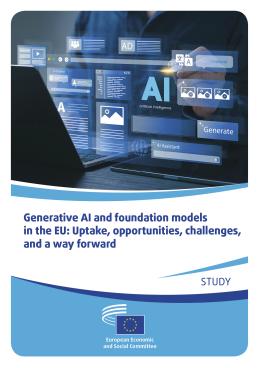
    Exploring the evolving landscape of generative artificial intelligence (GenAI) within the European Union, this study delves into technological advancements, market dynamics, and regulatory challenges. It highlights the EU’s position in the global GenAI ecosystem, revealing significant US dominance, while uncovering sector-specific opportunities and risks across industries such as automotive, renewable energy, and education.

  • The European Commission organised the third Civil Society Forum of the EU-UK trade and cooperation agreement (TCA) on 20 September 2024, at EESC premises, in Brussels.

    Participation was open to civil society organisations representing employers' organisations, workers' representatives, NGOs and academics.

    The agenda for this third meeting of the CSF included trade in goods, level playing field, regulatory cooperation, trade in services & energy.

  • The Domestic Advisory Groups (DAGs), set up under the EU-UK Trade and Cooperation Agreement (TCA) to advise on the implementation of the agreement, held their third meeting on 19 September 2024, in Brussels.

  • The EU DAG set up under the EU-UK TCA met ahead of the DAG-to-DAG meeting and the Civil Society Forum in preparation for these joint events. Exchanges focused on finalising the joint statement exercise and some anticipation on the discussions and opportunities that CSF would bring.

  • The 11th meeting of the EU DAG, which took place right after European elections and ahead of UK general election, was dedicated to members’ presentations on pressing ongoing issues, including CBAM, concerns around labour rights LPF and non-regression, the sand eel dispute and the transport of live animals and common veterinary.


  • Luísa Santos, the new Chair, welcomed the EU DAG to its 10th meeting, putting forward some actions and proposals to give more visibility to future meetings and improve cooperation with UK DAG. In the light of this approach, EU DAG members discussed the impact of recent developments in EU-UK relations as well as the priorities for the TCA review. 


  • The 9th meeting of the EU DAG set up under the EU-UK TCA, the last one chaired by Tanja Buzek (now vice-chair), was mostly dedicated to a debriefing on the DAG-to-DAG meeting and the 2nd Civil Society Forum (CSF) held in London on 6 and 7 November 2023. 


  • Published in
    97 pages

    EESC Own-initiative opinion on EU-UK Youth Engagement and technical report in support of the own-initiative opinion

  • Strengthening ties between young people and youth organisations in the European Union and the United Kingdom will have tangible positive effects on a generation of Europeans disproportionately affected by the consequences of Brexit, according to the European Economic and Social Committee (EESC).