
European Economic
and Social Committee
Green transport must be financially acceptable and socially feasible
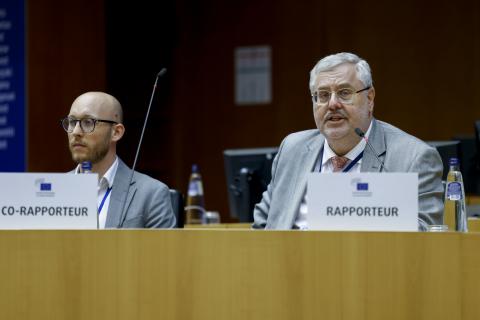
The April plenary session of the European Economic and Social Committee (EESC) saw the adoption of an opinion on the key factors for the transition to a long-term sustainable transport system.
Long-term sustainable transport is possible, but the transition can only happen if citizens, industry and the transport sector buy into two objectives: a 90% emission reduction in the transport sector by 2050 and a commitment to using the agreed ways and means to get to the final result.
This is the strong message sent by the EESC opinion drafted by Stefan Back and Mateusz Szymański and adopted at the plenary session on 27 April 2023.
To achieve the objective of long-term green transport, the transition must be attractive and realistic, and thus acceptable to citizens and businesses from three points of view: financial, social and practical,
said Mr Back.
That is the only way the transition can be actively supported by our society, otherwise the risk is not only failure, but at worst social unrest,
added Mr Szymański.
Three conditions for a successful transition
More specifically, the EESC says that in order for the transition to succeed, certain conditions must be fulfilled.
First of all, businesses must feel that they are not burdened with excessive costs and that they will retain competitiveness, not only within but also outside the EU.
Secondly, employees must experience the transition as acceptable and be given the possibility to adapt to new working conditions in a socially acceptable manner.
Thirdly, citizens both in agglomerations and rural areas must benefit from accessibility and mobility at a reasonable cost and under good general conditions.
Efficient transport infrastructure
The Committee also stresses that specific attention should be paid to transport infrastructure, and in particular to infrastructure for the distribution of alternative fuels, as well as investment and efficiency in infrastructure use, as all of these are a prerequisite for changes in transport.
Key issues here are transport accessibility, use of clean fuels, integration of modes of transport, implementation of innovations and new modes of transport.
Efficiency can also drive the transition. It improves transport sustainability and may be achieved through better loading capacity, improved infrastructure that makes transport quicker, and improved terminal infrastructure that speeds up loading/unloading and switching from one mode to another.
Work organisation
Recommended for you
YEYS! 2023: Jongeren vragen een EU die transparanter, digitaler en eenvoudiger is
News
Op 23 en 24 maart is bij het Europees Economisch en Sociaal Comité (EESC) de veertiende editie van Jouw Europa, jouw mening! (YEYS!) gehouden. Voor dat evenement kwamen 105 leerlingen van 35 scholen…
De elektriciteitsmarkt van de EU moet worden hervormd
News
Uit een door het Europees Economisch en Sociaal Comité (EESC) georganiseerd debat kwam naar voren dat het van cruciaal belang is de Europese elektriciteitsmarkt aan te passen om de zwakke punten…
Kandidaten kunnen zich nu aanmelden voor de EESC-prijs voor het maatschappelijk middenveld, die dit jaar geestelijke gezondheid als thema heeft
News
Maatschappelijke organisaties, individuen en particuliere ondernemingen kunnen nu met hun non-profitprojecten meedingen naar de EESC-prijs voor het maatschappelijk middenveld, die deze keer in het…
EESC roept de EU-burgers op om in juni 2024 te stemmen voor een verenigd en democratisch Europa
News
Tegen de achtergrond van een wereldwijde achteruitgang van de democratie, welig tierende desinformatie, groeiende ontevredenheid, stijgende inflatie en oorlogsdreiging, staat er veel op het spel bij…
De sociale en burgerdialoog kunnen de EU helpen duurzaam te groeien
News
Slechts enkele dagen na de Europese verkiezingen van 2024 kwamen het Europees Economisch en Sociaal Comité (EESC) en de nationale sociaal-economische raden van de EU bijeen om de stand van zaken van…