
European Economic
and Social Committee
Green transport must be financially acceptable and socially feasible
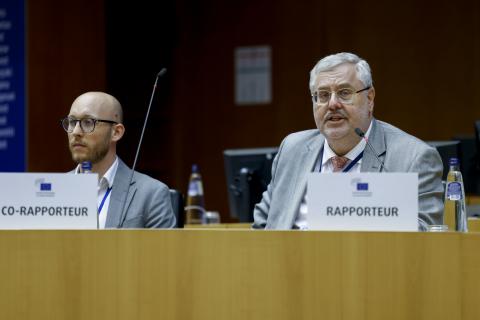
The April plenary session of the European Economic and Social Committee (EESC) saw the adoption of an opinion on the key factors for the transition to a long-term sustainable transport system.
Long-term sustainable transport is possible, but the transition can only happen if citizens, industry and the transport sector buy into two objectives: a 90% emission reduction in the transport sector by 2050 and a commitment to using the agreed ways and means to get to the final result.
This is the strong message sent by the EESC opinion drafted by Stefan Back and Mateusz Szymański and adopted at the plenary session on 27 April 2023.
To achieve the objective of long-term green transport, the transition must be attractive and realistic, and thus acceptable to citizens and businesses from three points of view: financial, social and practical,
said Mr Back.
That is the only way the transition can be actively supported by our society, otherwise the risk is not only failure, but at worst social unrest,
added Mr Szymański.
Three conditions for a successful transition
More specifically, the EESC says that in order for the transition to succeed, certain conditions must be fulfilled.
First of all, businesses must feel that they are not burdened with excessive costs and that they will retain competitiveness, not only within but also outside the EU.
Secondly, employees must experience the transition as acceptable and be given the possibility to adapt to new working conditions in a socially acceptable manner.
Thirdly, citizens both in agglomerations and rural areas must benefit from accessibility and mobility at a reasonable cost and under good general conditions.
Efficient transport infrastructure
The Committee also stresses that specific attention should be paid to transport infrastructure, and in particular to infrastructure for the distribution of alternative fuels, as well as investment and efficiency in infrastructure use, as all of these are a prerequisite for changes in transport.
Key issues here are transport accessibility, use of clean fuels, integration of modes of transport, implementation of innovations and new modes of transport.
Efficiency can also drive the transition. It improves transport sustainability and may be achieved through better loading capacity, improved infrastructure that makes transport quicker, and improved terminal infrastructure that speeds up loading/unloading and switching from one mode to another.
Work organisation
Recommended for you
Skrajni čas za vlaganje v mlade na Zahodnem Balkanu
News
Da bi vlade držav Zahodnega Balkana svojim državljanom zagotovile boljšo prihodnost, se morajo lotiti reševanja težav, s katerimi se srečujejo mladi, ki imajo ključno vlogo pri njenem ustvarjanju.…
Vaša Evropa, vaš glas! v letu 2023: Mladi si želijo, da bi bila EU preglednejša, bolj digitalna in enostavnejša
News
Evropski ekonomsko-socialni odbor (EESO) je 23. in 24. marca gostil dogodek Vaša Evropa, vaš glas! Potekal je v Bruslju, udeležilo pa se ga je 105 dijakov 35 šol iz vseh 27 držav članic EU in sedem…
Začetek zbiranja prijav za nagrade za civilno družbo EESO na temo duševnega zdravja
News
Organizacije civilne družbe, posamezniki in zasebna podjetja lahko svoje nepridobitne projekte prijavijo za nagrado EESO, namenjeno spodbujanju duševnega zdravja Evropejcev Evropski ekonomsko…
Oddajte svoj glas junija 2024: EESO poziva Evropejce, naj volijo za enotno in demokratično Evropo
News
Demokracija po vsem svetu nazaduje, širijo se dezinformacije in vse več je nezadovoljstva zaradi naraščajoče inflacije ter preteče nevarnosti vojne, zato so letošnje evropske volitve, na katerih bodo…
Ohranjanje zagona širitve EU: prizadevanje civilne družbe, da bi s postopnim vključevanjem prinesla koristi Zahodnemu Balkanu
News
Evropski ekonomsko-socialni odbor (EESO) je 20 let po pristopu Slovenije k EU v Ljubljani zbral politične voditelje in voditelje civilne družbe, da bi obeležili to simbolično obletnico in poudarili…