
European Economic
and Social Committee
Green transport must be financially acceptable and socially feasible
The April plenary session of the European Economic and Social Committee (EESC) saw the adoption of an opinion on the key factors for the transition to a long-term sustainable transport system.
Long-term sustainable transport is possible, but the transition can only happen if citizens, industry and the transport sector buy into two objectives: a 90% emission reduction in the transport sector by 2050 and a commitment to using the agreed ways and means to get to the final result.
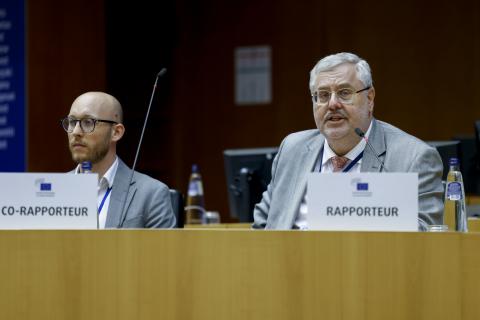
This is the strong message sent by the EESC opinion drafted by Stefan Back and Mateusz Szymański and adopted at the plenary session on 27 April 2023.
To achieve the objective of long-term green transport, the transition must be attractive and realistic, and thus acceptable to citizens and businesses from three points of view: financial, social and practical,
said Mr Back.
That is the only way the transition can be actively supported by our society, otherwise the risk is not only failure, but at worst social unrest,
added Mr Szymański.
Three conditions for a successful transition
More specifically, the EESC says that in order for the transition to succeed, certain conditions must be fulfilled.
First of all, businesses must feel that they are not burdened with excessive costs and that they will retain competitiveness, not only within but also outside the EU.
Secondly, employees must experience the transition as acceptable and be given the possibility to adapt to new working conditions in a socially acceptable manner.
Thirdly, citizens both in agglomerations and rural areas must benefit from accessibility and mobility at a reasonable cost and under good general conditions.
Efficient transport infrastructure
The Committee also stresses that specific attention should be paid to transport infrastructure, and in particular to infrastructure for the distribution of alternative fuels, as well as investment and efficiency in infrastructure use, as all of these are a prerequisite for changes in transport.
Key issues here are transport accessibility, use of clean fuels, integration of modes of transport, implementation of innovations and new modes of transport.
Efficiency can also drive the transition. It improves transport sustainability and may be achieved through better loading capacity, improved infrastructure that makes transport quicker, and improved terminal infrastructure that speeds up loading/unloading and switching from one mode to another.
Work organisation
Recommended for you
The greening transition in water transport must take into account people's health
News
The European Economic and Social Committee (EESC) says that the greening of river and seaport activities should consider the impact on the health and quality of life of local residents and workers.…
Energy transition – trust and fair procedures will increase social acceptance
News
Transparent decision-making and open communication will make the energy transition more acceptable to society despite the potentially higher initial costs, underlines the European Economic and Social…
Rapid roll-out of green hydrogen must consider social standards
News
The European Economic and Social Committee (EESC) recognises that green hydrogen is an important building block in the transition towards renewable energy sources, and says that its infrastructure,…
What conditions are needed for the energy and low-carbon transition to be socially acceptable?
Opinion
Key points To make the energy transition socially acceptable, taking into account feedback from the planning and implementation stages, the EESC calls on all stakeholders to improve the following:…
Social Dialogue within the Green Transition - Press Release
News
The transition towards a low-carbon economy is a fundamental priority. But the green transition will fail without social dialogue. This represented a general agreement among the discussions during…