
European Economic
and Social Committee
Green transport must be financially acceptable and socially feasible
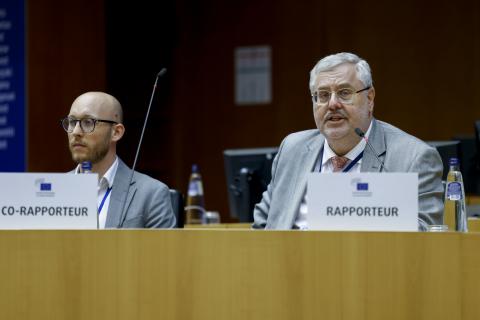
The April plenary session of the European Economic and Social Committee (EESC) saw the adoption of an opinion on the key factors for the transition to a long-term sustainable transport system.
Long-term sustainable transport is possible, but the transition can only happen if citizens, industry and the transport sector buy into two objectives: a 90% emission reduction in the transport sector by 2050 and a commitment to using the agreed ways and means to get to the final result.
This is the strong message sent by the EESC opinion drafted by Stefan Back and Mateusz Szymański and adopted at the plenary session on 27 April 2023.
To achieve the objective of long-term green transport, the transition must be attractive and realistic, and thus acceptable to citizens and businesses from three points of view: financial, social and practical,
said Mr Back.
That is the only way the transition can be actively supported by our society, otherwise the risk is not only failure, but at worst social unrest,
added Mr Szymański.
Three conditions for a successful transition
More specifically, the EESC says that in order for the transition to succeed, certain conditions must be fulfilled.
First of all, businesses must feel that they are not burdened with excessive costs and that they will retain competitiveness, not only within but also outside the EU.
Secondly, employees must experience the transition as acceptable and be given the possibility to adapt to new working conditions in a socially acceptable manner.
Thirdly, citizens both in agglomerations and rural areas must benefit from accessibility and mobility at a reasonable cost and under good general conditions.
Efficient transport infrastructure
The Committee also stresses that specific attention should be paid to transport infrastructure, and in particular to infrastructure for the distribution of alternative fuels, as well as investment and efficiency in infrastructure use, as all of these are a prerequisite for changes in transport.
Key issues here are transport accessibility, use of clean fuels, integration of modes of transport, implementation of innovations and new modes of transport.
Efficiency can also drive the transition. It improves transport sustainability and may be achieved through better loading capacity, improved infrastructure that makes transport quicker, and improved terminal infrastructure that speeds up loading/unloading and switching from one mode to another.
Work organisation
Recommended for you
EWSA: Die EU muss die soziale Nachhaltigkeit stärker ins Blickfeld rücken
News
Der Europäische Wirtschafts- und Sozialausschuss (EWSA) fordert die Europäische Kommission auf, einen längst überfälligen Bericht zu veröffentlichen und die Ausweitung des Anwendungsbereichs der EU…
Ko-Kreation von Dienstleistungen von allgemeinem Interesse im Bereich Gesundheit als Beitrag zur Stärkung der partizipativen Demokratie in der EU
News
Bei dieser vom Europäischen Wirtschafts- und Sozialausschuss (EWSA) und der Universität Debrecen organisierten Veranstaltung wurde hervorgehoben, wie wichtig die Ko-Kreation von Dienstleistungen von…
Zur Bekämpfung des Klimawandels werden mehr öffentliche Investitionen in die Energieinfrastruktur in der EU gebraucht
News
In einer auf der Plenartagung im September verabschiedeten Stellungnahme erläutert der Europäische Wirtschafts- und Sozialausschuss (EWSA), dass zur Verwirklichung der Energiewende und der Klimaziele…
Energie – EWSA warnt vor neuen Abhängigkeiten
News
Der Europäische Wirtschafts- und Sozialausschuss (EWSA) bezieht in einer auf seiner September-Plenartagung verabschiedeten Stellungnahme klar Stellung zum Thema Energie: Der Vorschlag der Kommission…
Der EU-US-Handels- und Technologierat muss die Dynamik nutzen, um ein Wegweiser für Handel, Technologie und Innovation zu werden
News
Auf seiner Juli-Plenartagung zeigte sich der Europäische Wirtschafts- und Sozialausschuss (EWSA) optimistisch, dass der neue Handels- und Technologierat (TTC) ein innovatives Instrument für die EU…