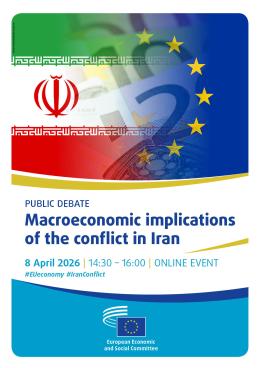
Public Debate | 8 April 2026 | 14:30-16:00 | Online Event Rising tensions and the renewed conflict in Iran adds new volatility to an already fragile global economic environment. Against a backdrop of geopolitical fragmentation, energy market uncertainty and slowing growth, understanding the macroeconomic implications of this conflict for Europe has become increasingly urgent. The Section for Economic and Monetary Union and Economic and Social Cohesion (ECO) of the EESC will organise a public debate to examine the broader macroeconomic consequences of the conflict in Iran for the European economy.
"Cohesion policy 2028–2034: A new fund, a new framework, a new role for civil society?" brings together EU institutions, social partners and civil society representatives to reflect on the future of cohesion policy in the next Multiannual Financial Framework. The hearing explores proposals for reforming cohesion funding and governance, assesses the implications of the new framework through the National and Regional Partnership Plans and examines how civil society organisations can play a stronger role in the design, implementation and monitoring of cohesion policy. The discussion aims to identify how cohesion policy can continue to deliver territorial, social and economic cohesion while responding to new challenges and transitions facing the European Union.
The legislative package proposed by the European Commission are likely to affect the availability of financial instruments for EU citizens, the returns of their savings and national policies on supplementary pensions. This event will gather institutions and civil society stakeholders.
To celebrate Bulgaria's accession to the euro zone, the ECO section organises a public debate to discuss Bulgaria's road to the euro, its prospects as part of the common currency area, and the outlook for the euro area in a world of geopolitical challenges, inflationary pressures and economic uncertainties.
Public debate in the ECO Section on the Latest twists and turns on the road to the next Multiannual Financial Framework in the framework of the opinion ECO/682 Multiannual financial framework 2028-2034.
The public hearing will examine how national, local and civil society actors will work together to foster collaboration through partnership principle and multi-level governance in order to deliver more inclusive, sustainable, and resilient outcomes across all regions.
Public debate on Defence-related investments in the EU budget in the context of the new geopolitical order, to contribute to the final report of the EESC´s ad hoc group on the new geopolitical order, and in the framework of the opinion ECO/679 - Defence-related investments in the EU budget.