
European Economic
and Social Committee
#ReskillEU – Europe's energy and transport workforce needs new skillset to make decarbonisation a reality
To make the decarbonisation of the EU's energy and transport a success, those sectors need workers equipped with "new" skills, the European Economic and Social Committee (EESC) warns, as it calls on policy-makers to act without delay.
The EU must have a structured and efficient plan to develop the critical skills that are needed, if the energy and transport transitions are to happen. Clean energy and transport urgently need new skills, knowledge and capacities, and the EU's pathway towards net zero emissions by 2050 can only be successful if it goes hand in hand with a workforce equipped with the right skillset.
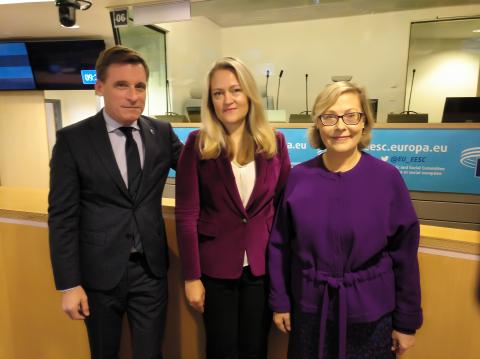
That was the main takeaway from the conference on #ReskillEU – new jobs for energy and transport in Europe, co-hosted by the EESC's Section for Transport, Energy, Infrastructure and the Information Society (TEN) and the European Commission's DG Research and Innovation in Brussels on 8 November 2023.
Referring to the importance of new skills and knowledge for a smooth green and digital transition in the transport and energy sector,
the EESC president Oliver Röpke stressed: A focus on the green and digital transition must not overlook the human element in achieving these goals. Only together can we achieve these ambitious goals and we need to make sure that all members of society are part of this transition.
What are the new skills needed, and for what new jobs in energy and transport in Europe?
To ensure that workers are equipped with the required "new" skills, the EU must act now, in line with the objectives set in the European Skills Agenda for 2025 and against the background of the European Year of Skills 2023.
The EU renewables sector currently needs over 1.2 million skilled workers and – according to the International Renewable Energy Agency – these figures are expected to increase annually until 2050.
The same goes for transport, which employs over 15 million people in the EU. Transport is a sector that is undergoing rapid transformation, and being shaped by a great deal by automation, electrification and greening technologies.
When we look at the energy and transport sectors in Europe, the magnitude of the skills challenge becomes strikingly clear,
pointed out Baiba Miltoviča, the TEN section president. We must ensure that the development of knowledge and skills, especially in the realm of green skills and training, is at the forefront of our efforts. This entails a commitment to continuous learning, retraining, and upskilling to meet the evolving demands of the clean energy and transport sectors.
The way forward: focus on research and innovation
The new skills can be developed through research and innovation activities. The Commission's Horizon Europe is the EU's flagship funding programme for research and innovation up to 2027. It supports skills development to facilitate the EU's green and digital transitions.
Speaking on behalf of the Association of European Renewable Energy Research Centres (EUREC), Nathalie Richet emphasised that multi-disciplinarity, inter-disciplinarity, mobility and multicultural approaches were vital, and that higher education programmes must expose their students to the latest tools, practices and know-how to be ready for the employment market.
According to Luigi Crema, representing Hydrogen Europe Research, the hydrogen sector is going through an accelerated scaling-up, encouraged by private and public factors and EU policies, and is expected to generate several hundred thousand jobs in Europe by 2030. However, to achieve this objective, it is crucial to develop modular and standardised training as well as to improve access to professional development.
Alco Weeke, from the educational and research institution STC Group, Maritime & Logistics University of applied sciences, highlighted that industry, workforce and education constituted a triangle that needed a level playing field to be able to fully cooperate to close the future skills gap. In this respect, vocational education and higher education had to go hand in hand to make the new workforce match the new needs.
Detailed conclusions from the conference will be published shortly on the EESC website.
Work organisation
Downloads
-
#ReskillEU – Europe's energy and transport workforce needs new skillset to make decarbonisation a reality
Recommended for you
„Sinu Euroopa, Sinu arvamus“ 2023: noored soovivad läbipaistvamat, digitaalsemat ja lihtsamat ELi
News
23. ja 24. märtsil korraldas Euroopa Majandus- ja Sotsiaalkomitee 14. korda ürituse „Sinu Euroopa, Sinu arvamus“. Üritus tõi Brüsselisse 105 õpilast 35 koolist kõigist 27…
Algab kandideerimine Euroopa Majandus- ja Sotsiaalkomitee kodanikuühiskonna auhinnale, mille teemaks on vaimne tervis
News
Kodanikuühiskonna organisatsioonid, üksikisikud ja eraettevõtted saavad nüüd esitada oma mittetulunduslikke projekte, et konkureerida Euroopa Majandus- ja Sotsiaalkomitee auhinnale, mis on pühendatud…
Valimised 2024. aasta juunis: Euroopa Majandus- ja Sotsiaalkomitee kutsub eurooplasi üles hääletama ühtse ja demokraatliku Euroopa poolt
News
Uue Euroopa Parlamendi valimistel on palju kaalul, sest demokraatia on nõrgenemas kogu maailmas, desinformatsioon on laialt levinud ja rahulolematus kasvab, kuna inflatsioon kiireneb ja sõjaoht…
TENi sektsiooni esimees Baiba Miltoviča ja Euroopa Regioonide Komitee raportöör Andres Jaadla kirjutavad alla elamumajandust käsitlevale deklaratsioonile
News
14. novembril 2024 allkirjastatud ühisavalduses kutsuvad Euroopa Majandus- ja Sotsiaalkomitee transpordi, energeetika, infrastruktuuri ja infoühiskonna sektsiooni (TEN) esimees Baiba…
EL peab transpordisektori CO2 heite vähendamiseks viivitamatult keskenduma saastevabale vesinikule
News
Eestis toimunud konverentsil rõhutati, et vähese CO2 heitega vesinik on energiasüsteemi eduka ümberkujundamise põhielement, mille potentsiaali arendamiseks on aga vaja taristut ja rahastamist.Ürituse…