At its March 2026 plenary session, the European Economic and Social Committee (EESC) adopted an exploratory opinion on how to ensure social inclusion and independent living for persons with disabilities through high‑quality, specialised social services. Building on the UN Convention on the Rights of Persons with Disabilities (UNCRPD), the Strategy for the Rights of Persons with Disabilities 2021–2030, and years of civil‑society advocacy, the Committee sets out a clear roadmap to close the gap between commitments and reality.
Europe is facing a pivotal moment. Social and economic inequalities, rapid technological change, anti-democratic forces and geopolitical instability are straining the foundations of the European project.
With democracy and civic space under mounting pressure, civil society organisations, human rights defenders and free media face growing constraints - from restrictive laws and disinformation campaigns to underfunding and public distrust. Deepening polarisation and eroding trust in institutions further undermine Europe’s democratic model.
Download — Γνωμοδότηση τμήμστος της ΕΟΚΕ: Ending forced sterilisation of women with disabilities: Alternative pathways to the decriminalisation of EU criminal offences through anti-discrimination law and conditionality of funds
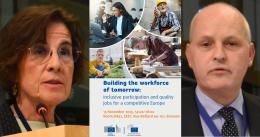
The EESC hosted a high-level conference on 13 November 2025, entitled “Building the workforce of tomorrow: inclusive participation and quality jobs for a competitive Europe.” The event brought together EU policymakers, social partners, researchers, and civil society to discuss the urgent challenges and opportunities facing Europe’s labour market, with a focus on two flagship reports.
The European Economic and Social Committee (EESC) acknowledges persistent trends towards institutionalisation & stresses the urgent need for a legally binding directive that translates Article 19 on legal capacity of the UN Convention on the Rights of Persons with Disabilities (UNCRPD) into concrete measures. Additionally, the EESC advocates for mandatory national de-institutionalisation strategies, developed in collaboration with disabled people’s organisations (DPOs), with allocated budgets, deadlines, and measurable targets. The EESC also urges the integration of de-institutionalisation into the EU’s affordable housing plan, ensuring accessibility requirements in all EU-funded housing projects & the development of national accessible housing strategies. Stronger coordination between ESF+, ERDF, & InvestEU is essential to expand community-based supported housing solutions.
Download — Γνωμοδότηση της ΕΟΚΕ: Social inclusion and independent living for persons with disabilities through high quality and specialized social services
This study examines how social partners and civil society organisations in six Member States — Italy, Austria, Hungary, Poland, Portugal and Sweden — view the effectiveness of current policies in raising employment levels and increasing adult participation in training. It also puts forward recommendations for improving policy outcomes.
urges the European Commission to adopt comprehensive action plans on all forms of disability, similar to those for youth and gender equality;
recommends closer cooperation with disabled people’s organisations (DPOs) in both international cooperation and EU humanitarian work, to enhance the effectiveness of disability diplomacy;
suggests that every diplomatic delegation involved in disability-related agreements should include at least one DPO representative at UN meetings. The aim is to formally designate disability focal points in each diplomatic delegation.
The EESC Section for Employment, Social Affairs and Citizenship (SOC) organised a hearing on "Accessible and Affordable Housing for All: Ensuring Inclusion of Persons with Disabilities in the EU". It brought together voices from the EU institutions, civil society, disability organisations and housing experts to address the urgent challenge of affordable and accessible housing across Europe.