European Economic
and Social Committee
European Economic
and Social Committee
The European Economic and Social Committee (EESC) is the voice of organised civil society in Europe.
Find out more about its role and structure at http://www.eesc.europa.eu/en/about
The EESC issues between 160 and 190 opinions, evaluation and information reports a year.
It also organises several annual initiatives and events with a focus on civil society and citizens’ participation such as the Civil Society Prize, the Civil Society Days, the Your Europe, Your Say youth plenary and the ECI Day.
Find the latest EESC opinions and publications at http://www.eesc.europa.eu/en/our-work/opinions-information-reports/opinions and http://www.eesc.europa.eu/en/our-work/publications-other-work/publications respectively.
The EESC is active in a wide range of areas, from social affairs to economy, energy and sustainability.
Learn more about our policy areas and policy highlights at http://www.eesc.europa.eu/en/policies
The EESC holds nine plenary sessions per year. It also organises many conferences, public hearings and high-level debates related to its work.
Find out more about our upcoming events at http://www.eesc.europa.eu/en/agenda/our-events/upcoming-events
Here you can find news and information about the EESC'swork, including its social media accounts, the EESC Info newsletter, photo galleries and videos.
Read the latest EESC news http://www.eesc.europa.eu/en/news-media/news and press releases http://www.eesc.europa.eu/en/news-media/press-releases
The EESC brings together representatives from all areas of organised civil society, who give their independent advice on EU policies and legislation. The EESC's326 Members are organised into three groups: Employers, Workers and Various Interests.
Find out more about our Members and groups at http://www.eesc.europa.eu/en/members-groups
The EESC has six sections, specialising in concrete topics of relevance to the citizens of the European Union, ranging from social to economic affairs, energy, environment, external relations or the internal market.
Find out more at http://www.eesc.europa.eu/en/sections-other-bodies
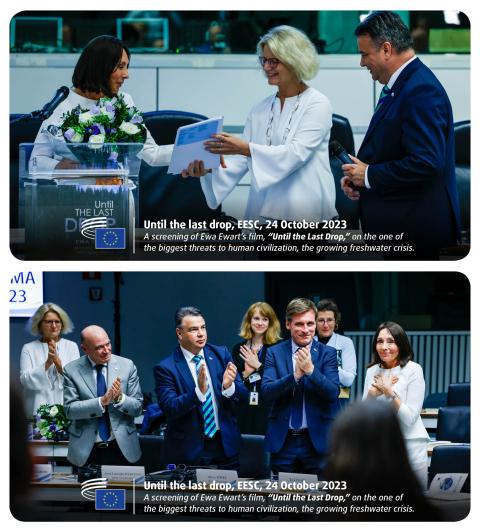
Η Ευρωπαϊκή Οικονομική και Κοινωνική Επιτροπή προέβαλε την ταινία «Μέχρι την τελευταία σταγόνα» με θέμα την αυξανόμενη κρίση των γλυκών υδάτων, παρουσία της Πολωνής σκηνοθέτριας Ewa Ewart. Η προβολή αυτή αποτέλεσε μέρος μιας σειράς εκδηλώσεων της ΕΟΚΕ με θέμα το νερό, που κορυφώθηκε με τη διάσκεψη «Αίτημα για μια Γαλάζια Συμφωνία της ΕΕ», κατά την οποία η ΕΟΚΕ παρουσίασε τη στρατηγική της για τα ύδατα στην ΕΕ.
«Το νερό είναι ζωή, ας το προστατέψουμε και ας το φροντίσουμε. Χωρίς νερό δεν υπάρχει ζωή στον πλανήτη» δήλωσε η Ewa Ewart προλογίζοντας την προβολή του ντοκιμαντέρ της με θέμα το νερό στις 24 Οκτωβρίου στις Βρυξέλλες.
Την έναρξη της εκδήλωσης κήρυξε ο Πρόεδρος της ΕΟΚΕ Oliver Röpke, με τη συμμετοχή του Αντιπροέδρου Laurențiu Plosceanu και του μέλους Pietro De Lotto, που πρωτοστάτησε στην πρωτοβουλία της ΕΟΚΕ για τη Γαλάζια Συμφωνία. Εκατό και πλέον προσκεκλημένοι παρακολούθησαν την προβολή, συμπεριλαμβανομένων μελών της ΕΟΚΕ, εκπροσώπων της ΕΕ και δημοσιογράφων.
Οι ταινίες της Ewa Ewart πραγματεύονται ακανθώδη ζητήματα και φλέγοντα θέματα. Η Ewa Ewart έχει αποτυπώσει ιστορίες στο μεταίχμιο ζωής και θανάτου. Οι ταινίες της μιλούν για τους ανθρώπους και τους πολέμους. «Η ταινία «Μέχρι την τελευταία σταγόνα» μιλά επίσης για έναν πόλεμο», αναφέρει η Ewa Ewart.
«Αφηγείται την ιστορία ενός διαφορετικού πολέμου, του πιο ηλίθιου απ’ όλους. Είναι μια ιστορία για τον πόλεμο που κήρυξε ο άνθρωπος στο νερό —την πηγή της ζωής— στο όνομα της προόδου. Και για την ελπίδα που μπορούμε να βρούμε εάν εστιάσουμε στους ποταμούς μας, την πρωτογενή πηγή του γλυκού και καθαρού νερού που χρειαζόμαστε για να υπάρχουμε. Κάθε μέρα, όλο και περισσότεροι άνθρωποι συνειδητοποιούν ότι δεν μας μένει και πολύς χρόνος προτού να είναι πολύ αργά για να αλλάξουμε τον τρόπο με τον οποίο χρησιμοποιούμε το νερό, τον πολυτιμότερο πόρο μας». (αρχισυντάκτης)