European Economic
and Social Committee
European Economic
and Social Committee
The European Economic and Social Committee (EESC) is the voice of organised civil society in Europe.
Find out more about its role and structure at http://www.eesc.europa.eu/en/about
The EESC issues between 160 and 190 opinions, evaluation and information reports a year.
It also organises several annual initiatives and events with a focus on civil society and citizens’ participation such as the Civil Society Prize, the Civil Society Days, the Your Europe, Your Say youth plenary and the ECI Day.
Find the latest EESC opinions and publications at http://www.eesc.europa.eu/en/our-work/opinions-information-reports/opinions and http://www.eesc.europa.eu/en/our-work/publications-other-work/publications respectively.
The EESC is active in a wide range of areas, from social affairs to economy, energy and sustainability.
Learn more about our policy areas and policy highlights at http://www.eesc.europa.eu/en/policies
The EESC holds nine plenary sessions per year. It also organises many conferences, public hearings and high-level debates related to its work.
Find out more about our upcoming events at http://www.eesc.europa.eu/en/agenda/our-events/upcoming-events
Here you can find news and information about the EESC'swork, including its social media accounts, the EESC Info newsletter, photo galleries and videos.
Read the latest EESC news http://www.eesc.europa.eu/en/news-media/news and press releases http://www.eesc.europa.eu/en/news-media/press-releases
The EESC brings together representatives from all areas of organised civil society, who give their independent advice on EU policies and legislation. The EESC's326 Members are organised into three groups: Employers, Workers and Various Interests.
Find out more about our Members and groups at http://www.eesc.europa.eu/en/members-groups
The EESC has six sections, specialising in concrete topics of relevance to the citizens of the European Union, ranging from social to economic affairs, energy, environment, external relations or the internal market.
Find out more at http://www.eesc.europa.eu/en/sections-other-bodies
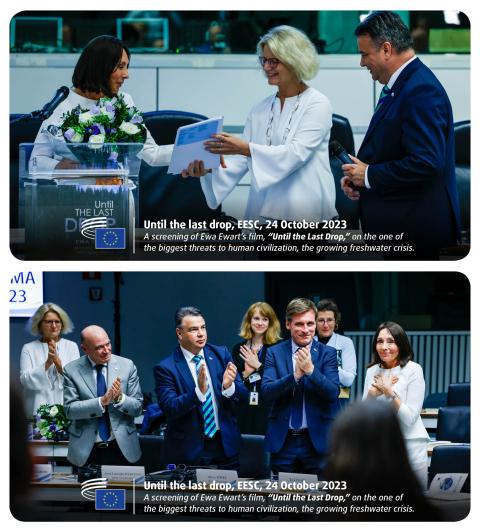
The European Economic and Social Committee held a screening of the film “Until the last drop,” about the growing freshwater crisis, in the presence of Polish film director Ewa Ewart. The screening, was part of a series of EESC events on the topic of water, culminating in the conference “Call for an EU Blue Deal”, where the Committee unveiled its water strategy for the EU.
"Water is life, let us protect and care for it. No water, no life on this planet", said Ewa Ewart introducing the screening of her documentary on water on 24 October in Brussels.
The event was opened by EESC President Oliver Röpke, with the participation of Vice President Laurențiu Plosceanu and member Pietro De Lotto, who spearheaded the EESC Blue Deal Initiative. Over 100 guests attended the screeening, including EESC members, EU representatives and journalists.
Ewa Ewart's films deal with difficult issues and dangerous subjects. She has depicted stories on the borderline between life and death. Her films talk of people and wars. "Until the last drop" is also about war, she says: "It tells the story of a different war, the stupidest of all. It is a story about the war man declared on water – a source of life – in the name of progress. And the hope we can find where we are concentrating on our rivers – the primary source of fresh, clean water we need to exist. Every day, more and more people are becoming aware that we do not have much time before it is too late to change how we manage water – our most precious resource". (ehp)