European Economic
and Social Committee
European Economic
and Social Committee
The European Economic and Social Committee (EESC) is the voice of organised civil society in Europe.
Find out more about its role and structure at http://www.eesc.europa.eu/en/about
The EESC issues between 160 and 190 opinions, evaluation and information reports a year.
It also organises several annual initiatives and events with a focus on civil society and citizens’ participation such as the Civil Society Prize, the Civil Society Days, the Your Europe, Your Say youth plenary and the ECI Day.
Find the latest EESC opinions and publications at http://www.eesc.europa.eu/en/our-work/opinions-information-reports/opinions and http://www.eesc.europa.eu/en/our-work/publications-other-work/publications respectively.
The EESC is active in a wide range of areas, from social affairs to economy, energy and sustainability.
Learn more about our policy areas and policy highlights at http://www.eesc.europa.eu/en/policies
The EESC holds nine plenary sessions per year. It also organises many conferences, public hearings and high-level debates related to its work.
Find out more about our upcoming events at http://www.eesc.europa.eu/en/agenda/our-events/upcoming-events
Here you can find news and information about the EESC'swork, including its social media accounts, the EESC Info newsletter, photo galleries and videos.
Read the latest EESC news http://www.eesc.europa.eu/en/news-media/news and press releases http://www.eesc.europa.eu/en/news-media/press-releases
The EESC brings together representatives from all areas of organised civil society, who give their independent advice on EU policies and legislation. The EESC's326 Members are organised into three groups: Employers, Workers and Various Interests.
Find out more about our Members and groups at http://www.eesc.europa.eu/en/members-groups
The EESC has six sections, specialising in concrete topics of relevance to the citizens of the European Union, ranging from social to economic affairs, energy, environment, external relations or the internal market.
Find out more at http://www.eesc.europa.eu/en/sections-other-bodies
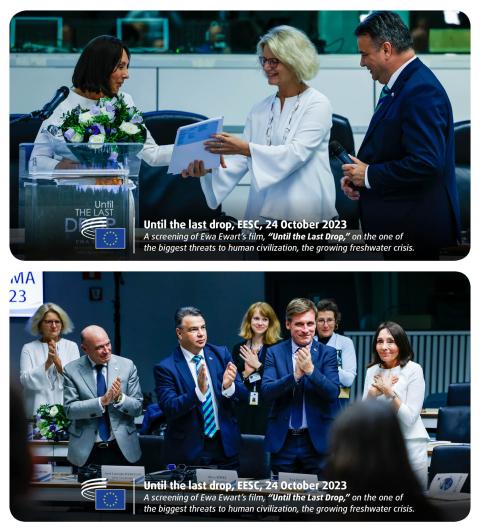
Der Europäische Wirtschafts- und Sozialausschuss zeigte in Anwesenheit der polnischen Regisseurin Ewa Ewart ihren Film „Until the last drop“ über die zunehmende Süßwasserkrise. Die Vorführung war Teil einer Reihe von EWSA-Veranstaltungen zum Thema Wasser, die in der Konferenz „Aufruf für einen europäischen Blauen Deal“ mündeten, auf der der Ausschuss seine Wasserstrategie für die EU vorstellte.
„Wasser ist Leben. Wir müssen es beschützen und erhalten. Kein Wasser – kein Leben auf diesem Planeten“, so Ewa Ewart zu Beginn der Vorführung ihres Dokumentarfilms zum Thema Wasser am 24. Oktober in Brüssel.
Eröffnet wurde die Veranstaltung von EWSA-Präsident Oliver Röpke unter Teilnahme von Vizepräsident Laurențiu Plosceanu und Ausschussmitglied Pietro De Lotto, die treibende Kraft der EWSA-Initiative zum Blauen Deal. Unter den über 100 Zuschauern waren u. a. EWSA-Mitglieder, Vertreterinnen und Vertreter von EU-Institutionen sowie Journalistinnen und Journalisten.
Ihre Filme widmet Ewa Ewart schwierigen Themen und gefährlichen Kontexten. Es geht darin oft um Geschichten über die Grenze zwischen Leben und Tod. Um Menschen und Kriege. „Auch in ‚Until the last drop‘ geht es um Krieg“, erklärt sie.
„Um einen besonderen Krieg, den sinnlosesten von allen. Es ist eine Geschichte über den Krieg, den der Mensch im Namen des Fortschritts unserer Lebensquelle Wasser erklärt hat. Sowie über die Zuversicht, dass es noch nicht zu spät ist, um uns um den Erhalt unserer Flüsse zu kümmern: die Hauptquelle für frisches, sauberes Wasser, das wir zum Überleben brauchen. Tag für Tag werden sich immer mehr Menschen bewusst, dass uns nicht mehr viel Zeit bleibt, unseren Umgang mit Wasser – unserer wertvollsten Ressource – zu ändern.“ (Chefredakteur)