European Economic
and Social Committee
European Economic
and Social Committee
The European Economic and Social Committee (EESC) is the voice of organised civil society in Europe.
Find out more about its role and structure at http://www.eesc.europa.eu/en/about
The EESC issues between 160 and 190 opinions, evaluation and information reports a year.
It also organises several annual initiatives and events with a focus on civil society and citizens’ participation such as the Civil Society Prize, the Civil Society Days, the Your Europe, Your Say youth plenary and the ECI Day.
Find the latest EESC opinions and publications at http://www.eesc.europa.eu/en/our-work/opinions-information-reports/opinions and http://www.eesc.europa.eu/en/our-work/publications-other-work/publications respectively.
The EESC is active in a wide range of areas, from social affairs to economy, energy and sustainability.
Learn more about our policy areas and policy highlights at http://www.eesc.europa.eu/en/policies
The EESC holds nine plenary sessions per year. It also organises many conferences, public hearings and high-level debates related to its work.
Find out more about our upcoming events at http://www.eesc.europa.eu/en/agenda/our-events/upcoming-events
Here you can find news and information about the EESC'swork, including its social media accounts, the EESC Info newsletter, photo galleries and videos.
Read the latest EESC news http://www.eesc.europa.eu/en/news-media/news and press releases http://www.eesc.europa.eu/en/news-media/press-releases
The EESC brings together representatives from all areas of organised civil society, who give their independent advice on EU policies and legislation. The EESC's326 Members are organised into three groups: Employers, Workers and Various Interests.
Find out more about our Members and groups at http://www.eesc.europa.eu/en/members-groups
The EESC has six sections, specialising in concrete topics of relevance to the citizens of the European Union, ranging from social to economic affairs, energy, environment, external relations or the internal market.
Find out more at http://www.eesc.europa.eu/en/sections-other-bodies
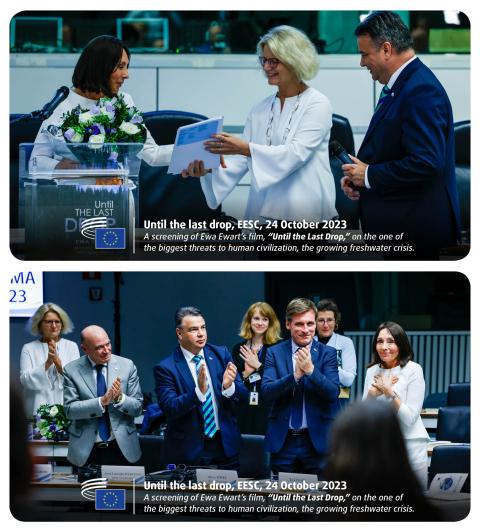
O Comité Económico e Social Europeu organizou uma sessão de projeção do filme «Until the last drop» [Até à última gota] sobre o agravamento da crise de água doce, com a presença da realizadora polaca Ewa Ewart. Esta sessão integra-se numa série de eventos do CESE sobre o tema dos recursos hídricos, que culminou na conferência «Apelo “Em prol de um Pacto Azul Europeu”», em que o Comité defendeu a sua estratégia para a UE em matéria de água.
«Água é vida. Temos de proteger este recurso e cuidar dele porque sem água não há vida no nosso planeta», afirmou Ewa Ewart na apresentação do seu documentário sobre a água, em 24 de outubro, em Bruxelas.
Oliver Röpke, presidente do CESE, abriu a sessão, que contou também com a participação de Laurențiu Plosceanu, vice-presidente do CESE, e de Pietro De Lotto, membro que liderou a iniciativa do CESE em prol de um Pacto Azul Europeu. Assistiram à projeção do documentário mais de 100 convidados, incluindo membros do Comité, representantes das instituições da UE e jornalistas.
Os filmes de Ewa Ewart abordam questões difíceis e sensíveis. Os seus enredos desenrolam-se frequentemente na fronteira entre a vida e a morte, falam de pessoas e de guerras. «“Until the last drop” também é um filme sobre a guerra», asseverou.
«Uma guerra diferente, a mais estúpida de todas. É a história da guerra que o ser humano declarou à água, fonte de vida, em nome do progresso. Mas também da esperança que podemos encontrar nos nossos rios: a principal fonte de água doce e limpa de que necessitamos para viver. Todos os dias cada vez mais pessoas tomam consciência de que já não temos muito tempo antes que seja tarde de mais para mudar a forma como gerimos a água, o nosso recurso mais precioso.» (chefe de redação)