European Economic
and Social Committee
European Economic
and Social Committee
The European Economic and Social Committee (EESC) is the voice of organised civil society in Europe.
Find out more about its role and structure at http://www.eesc.europa.eu/en/about
The EESC issues between 160 and 190 opinions, evaluation and information reports a year.
It also organises several annual initiatives and events with a focus on civil society and citizens’ participation such as the Civil Society Prize, the Civil Society Days, the Your Europe, Your Say youth plenary and the ECI Day.
Find the latest EESC opinions and publications at http://www.eesc.europa.eu/en/our-work/opinions-information-reports/opinions and http://www.eesc.europa.eu/en/our-work/publications-other-work/publications respectively.
The EESC is active in a wide range of areas, from social affairs to economy, energy and sustainability.
Learn more about our policy areas and policy highlights at http://www.eesc.europa.eu/en/policies
The EESC holds nine plenary sessions per year. It also organises many conferences, public hearings and high-level debates related to its work.
Find out more about our upcoming events at http://www.eesc.europa.eu/en/agenda/our-events/upcoming-events
Here you can find news and information about the EESC'swork, including its social media accounts, the EESC Info newsletter, photo galleries and videos.
Read the latest EESC news http://www.eesc.europa.eu/en/news-media/news and press releases http://www.eesc.europa.eu/en/news-media/press-releases
The EESC brings together representatives from all areas of organised civil society, who give their independent advice on EU policies and legislation. The EESC's326 Members are organised into three groups: Employers, Workers and Various Interests.
Find out more about our Members and groups at http://www.eesc.europa.eu/en/members-groups
The EESC has six sections, specialising in concrete topics of relevance to the citizens of the European Union, ranging from social to economic affairs, energy, environment, external relations or the internal market.
Find out more at http://www.eesc.europa.eu/en/sections-other-bodies
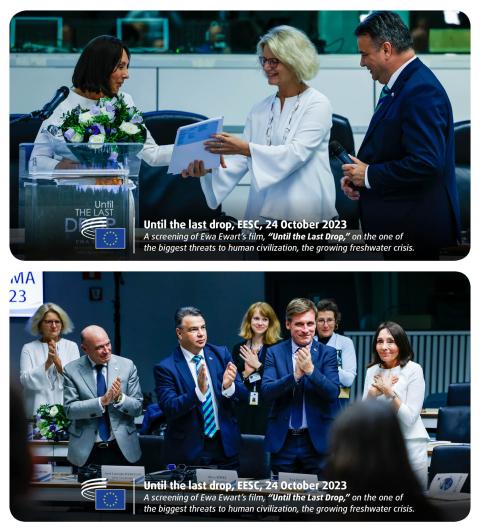
Bij het Europees Economisch en Sociaal Comité is onlangs de film “Until the last drop” over de groeiende zoetwatercrisis vertoond, in aanwezigheid van de Poolse filmregisseur Ewa Ewart. De filmvertoning vond plaats in het kader van een reeks evenementen rond het thema water. Hoogtepunt daarvan was de conferentie “Call for an EU Blue Deal”, waar het EESC zijn ideeën omtrent een EU-waterstrategie heeft ontvouwd.
“Water is leven, laten we het beschermen en er goed voor zorgen. Zonder water is er geen leven mogelijk op deze planeet”, zei Ewa Ewart voorafgaand aan de vertoning van haar documentaire op 24 oktober in Brussel.
De voorstelling werd geopend door EESC-voorzitter Oliver Röpke in het bijzijn van vicevoorzitter Laurențiu Plosceanu en EESC-lid Pietro De Lotto, de man achter het Blue Deal-initiatief van het EESC. De filmvertoning werd bijgewoond door meer dan 100 gasten, waaronder leden van het EESC, vertegenwoordigers van EU-instellingen en journalisten.
Ewa Ewart maakt films over heikele kwesties en gevaarlijke onderwerpen. Haar verhalen spelen zich af op de grens tussen leven en dood. Haar films gaan over mensen en oorlogen. “Until the last drop” gaat ook over oorlog, zegt ze.
“Deze documentaire vertelt het verhaal van een andere oorlog, de stomste van allemaal. Het is het verhaal van de oorlog die de mens heeft verklaard aan water – bron van leven – in naam van de vooruitgang. En van de hoop die het ons kan bieden als we meer aandacht besteden aan onze rivieren: de belangrijkste bron van schoon zoet water, dat we nodig hebben voor ons bestaan. Elke dag worden steeds meer mensen zich ervan bewust dat het vijf voor twaalf is, dat we echt anders moeten omgaan met water – onze meest waardevolle grondstof – voordat het te laat is.” (editor-in-chief)