European Economic
and Social Committee
European Economic
and Social Committee
The European Economic and Social Committee (EESC) is the voice of organised civil society in Europe.
Find out more about its role and structure at http://www.eesc.europa.eu/en/about
The EESC issues between 160 and 190 opinions, evaluation and information reports a year.
It also organises several annual initiatives and events with a focus on civil society and citizens’ participation such as the Civil Society Prize, the Civil Society Days, the Your Europe, Your Say youth plenary and the ECI Day.
Find the latest EESC opinions and publications at http://www.eesc.europa.eu/en/our-work/opinions-information-reports/opinions and http://www.eesc.europa.eu/en/our-work/publications-other-work/publications respectively.
The EESC is active in a wide range of areas, from social affairs to economy, energy and sustainability.
Learn more about our policy areas and policy highlights at http://www.eesc.europa.eu/en/policies
The EESC holds nine plenary sessions per year. It also organises many conferences, public hearings and high-level debates related to its work.
Find out more about our upcoming events at http://www.eesc.europa.eu/en/agenda/our-events/upcoming-events
Here you can find news and information about the EESC'swork, including its social media accounts, the EESC Info newsletter, photo galleries and videos.
Read the latest EESC news http://www.eesc.europa.eu/en/news-media/news and press releases http://www.eesc.europa.eu/en/news-media/press-releases
The EESC brings together representatives from all areas of organised civil society, who give their independent advice on EU policies and legislation. The EESC's326 Members are organised into three groups: Employers, Workers and Various Interests.
Find out more about our Members and groups at http://www.eesc.europa.eu/en/members-groups
The EESC has six sections, specialising in concrete topics of relevance to the citizens of the European Union, ranging from social to economic affairs, energy, environment, external relations or the internal market.
Find out more at http://www.eesc.europa.eu/en/sections-other-bodies
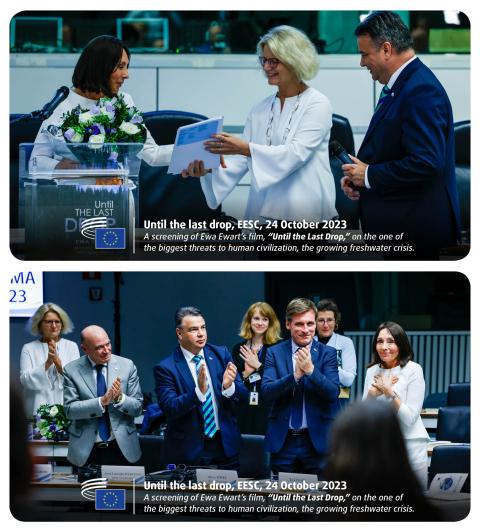
Europeiska ekonomiska och sociala kommittén har visat filmen ”Until the Last Drop” om den växande sötvattenkrisen, i närvaro av den polska filmregissören Ewa Ewart. Filmvisningen var ett i raden av de EESK-evenemang om vatten som kulminerade i konferensen ”Efterlysning av en blå giv för EU”, där kommittén presenterade sin vattenstrategi för EU.
”Vatten är liv, så låt oss skydda och vårda denna resurs. Utan vatten finns det inget liv på vår planet”, sade Ewa Ewart när hon presenterade sin dokumentär om vatten den 24 oktober i Bryssel.
Evenemanget inleddes med ett anförande av Oliver Röpke, EESK:s ordförande. Dessutom deltog vice ordförande Laurențiu Plosceanu och Pietro de Lotto, ledamoten som lett arbetet med EESK:s initiativ om den blå given. Över hundra gäster var på plats vid visningen, inbegripet EESK-ledamöter, EU-företrädare och journalister.
Ewa Ewart behandlar svåra frågor och farliga ämnen i sina filmer. Hon har berättat om gränslandet mellan liv och död. Hennes filmer handlar om människor och krig. Även ”Until the Last Drop” handlar om krig, säger hon.
”Den berättar om ett krig av ett annorlunda slag, det mest idiotiska kriget av de alla. Det är en berättelse om det krig som människan i framåtskridandets namn har förklarat mot vattnet, en källa till liv. Men också om det hopp vi kan finna genom att fokusera på våra floder – den främsta källan till färskt och rent vatten, oumbärligt för vår existens. Var dag blir fler och fler människor alltmer medvetna om att vi inte har mycket tid kvar innan det är för sent att ändra på hur vi tar hand om vattnet, vår mest värdefulla resurs.” (chefredaktör)