European Economic
and Social Committee
European Economic
and Social Committee
The European Economic and Social Committee (EESC) is the voice of organised civil society in Europe.
Find out more about its role and structure at http://www.eesc.europa.eu/en/about
The EESC issues between 160 and 190 opinions, evaluation and information reports a year.
It also organises several annual initiatives and events with a focus on civil society and citizens’ participation such as the Civil Society Prize, the Civil Society Days, the Your Europe, Your Say youth plenary and the ECI Day.
Find the latest EESC opinions and publications at http://www.eesc.europa.eu/en/our-work/opinions-information-reports/opinions and http://www.eesc.europa.eu/en/our-work/publications-other-work/publications respectively.
The EESC is active in a wide range of areas, from social affairs to economy, energy and sustainability.
Learn more about our policy areas and policy highlights at http://www.eesc.europa.eu/en/policies
The EESC holds nine plenary sessions per year. It also organises many conferences, public hearings and high-level debates related to its work.
Find out more about our upcoming events at http://www.eesc.europa.eu/en/agenda/our-events/upcoming-events
Here you can find news and information about the EESC'swork, including its social media accounts, the EESC Info newsletter, photo galleries and videos.
Read the latest EESC news http://www.eesc.europa.eu/en/news-media/news and press releases http://www.eesc.europa.eu/en/news-media/press-releases
The EESC brings together representatives from all areas of organised civil society, who give their independent advice on EU policies and legislation. The EESC's326 Members are organised into three groups: Employers, Workers and Various Interests.
Find out more about our Members and groups at http://www.eesc.europa.eu/en/members-groups
The EESC has six sections, specialising in concrete topics of relevance to the citizens of the European Union, ranging from social to economic affairs, energy, environment, external relations or the internal market.
Find out more at http://www.eesc.europa.eu/en/sections-other-bodies
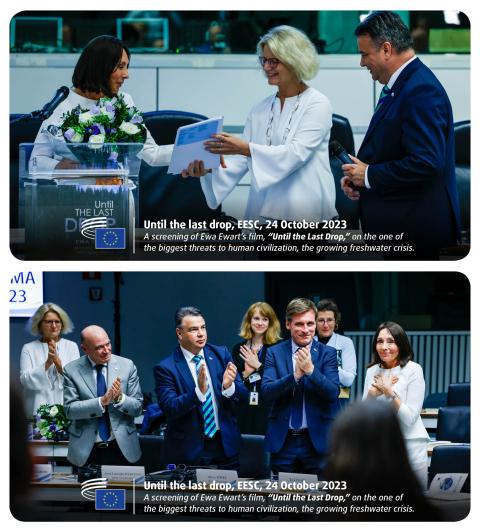
Euroopa Majandus- ja Sotsiaalkomitee korraldas Poola režissööri Ewa Ewarti kohalolekul filmi „Until the Last Drop“ linastuse. Filmi teemaks on süvenev mageveekriis. Filmilinastus oli osa komitee veeteemalisest üritustesarjast, mis kulmineerus konverentsiga „Üleskutse sõlmida ELi sinine kokkulepe“, kus komitee tutvustas oma ELi veestrateegiat.
„Vesi on elu alus, kaitskem seda ja kandkem selle eest hoolt. Ilma veeta pole elu meie planeedil,“ ütles Ewa Ewart oma veeteemalise dokumentaalfilmi sissejuhatuseks Brüsselis 24. oktoobril toimunud linastusel.
Ürituse avas komitee president Oliver Röpke, osa võtsid asepresident Aurel Laurențiu Plosceanu ja liige Pietro Francesco De Lotto, kes juhtis komitee algatust „Sinine kokkulepe“. Üritusel osales üle 100 külalise, nende hulgas komitee liikmed, ELi esindajad ja ajakirjanikud.
Ewa Ewarti filmid käsitlevad keerulisi probleeme ja ohtlikke teemasid. Ta on kujutanud lugusid, mis leiavad aset elu ja surma piiril. Tema filmid räägivad inimestest ja sõdadest. „Until the Last Drop“ on samuti lugu sõjast, ütles ta.
„See jutustab teistsugusest sõjast, kõige rumalamast sõjast üldse. See on lugu sõjast, mille inimene kuulutab progressi nimel veele, elu allikale. Samuti lootusest, mida võime leida, kui keskendume jõgedele, mis on meile vajaliku puhta magevee peamine allikas. Iga päevaga hakkavad inimesed üha enam mõistma, et meil ei ole palju aega jäänud selleni, kui veemajandust on juba liiga hilja muuta. Vesi on meie kõige väärtuslikum ressurss.“ (peatoimetaja)