European Economic
and Social Committee
European Economic
and Social Committee
The European Economic and Social Committee (EESC) is the voice of organised civil society in Europe.
Find out more about its role and structure at http://www.eesc.europa.eu/en/about
The EESC issues between 160 and 190 opinions, evaluation and information reports a year.
It also organises several annual initiatives and events with a focus on civil society and citizens’ participation such as the Civil Society Prize, the Civil Society Days, the Your Europe, Your Say youth plenary and the ECI Day.
Find the latest EESC opinions and publications at http://www.eesc.europa.eu/en/our-work/opinions-information-reports/opinions and http://www.eesc.europa.eu/en/our-work/publications-other-work/publications respectively.
The EESC is active in a wide range of areas, from social affairs to economy, energy and sustainability.
Learn more about our policy areas and policy highlights at http://www.eesc.europa.eu/en/policies
The EESC holds nine plenary sessions per year. It also organises many conferences, public hearings and high-level debates related to its work.
Find out more about our upcoming events at http://www.eesc.europa.eu/en/agenda/our-events/upcoming-events
Here you can find news and information about the EESC'swork, including its social media accounts, the EESC Info newsletter, photo galleries and videos.
Read the latest EESC news http://www.eesc.europa.eu/en/news-media/news and press releases http://www.eesc.europa.eu/en/news-media/press-releases
The EESC brings together representatives from all areas of organised civil society, who give their independent advice on EU policies and legislation. The EESC's326 Members are organised into three groups: Employers, Workers and Various Interests.
Find out more about our Members and groups at http://www.eesc.europa.eu/en/members-groups
The EESC has six sections, specialising in concrete topics of relevance to the citizens of the European Union, ranging from social to economic affairs, energy, environment, external relations or the internal market.
Find out more at http://www.eesc.europa.eu/en/sections-other-bodies
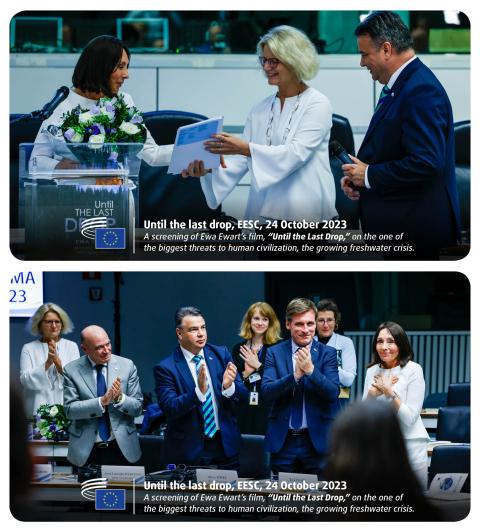
Európsky hospodársky a sociálny výbor usporiadal premietanie filmu s názvom Until the last drop (Do poslednej kvapky) venovaného problematike čoraz kritickejšieho stavu sladkovodných zdrojov. Na podujatí bola prítomná aj autorka filmu, poľská režisérka Ewa Ewart. Premietanie bolo súčasťou série podujatí EHSV na tému vody, ktoré vyvrcholili konferenciou s názvom Výzva na prijatie európskej modrej dohody EÚ. Na nej výbor predstavil svoju vodohospodársku stratégiu pre EÚ.
„Voda znamená život, preto ju musíme chrániť a starať sa o ňu. Bez vody nemôže na tejto planéte existovať život.“ Týmito slovami uviedla Ewa Ewart premietanie svojho dokumentárneho filmu 24. októbra v Bruseli.
Podujatie otvoril predseda EHSV Oliver Röpke a zúčastnili sa na ňom aj podpredseda výboru Laurențiu Plosceanu a člen výboru Pietro De Lotto, ktorý sa v EHSV venuje iniciatíve týkajúcej sa modrej dohody. Premietanie si nenechalo ujsť vyše sto hostí vrátane členov EHSV, zástupcov EÚ a novinárov.
Ewa Ewart sa vo svojich filmoch venuje ťažkým témam a nebezpečným situáciám. Zachytáva príbehy na hranici medzi životom a smrťou. Jej filmy hovoria o ľuďoch a vojnách. Film Until the last drop je podľa režisérky tiež o vojne.
„Rozpráva príbeh inej vojny – najhlúpejšej zo všetkých. Je to príbeh o človeku, ktorý v mene pokroku vyhlásil vojnu vode, bez ktorej sám nedokáže žiť, ale aj o nádeji, ktorú si môžeme zachovať, ak sa budeme starať o naše rieky ako hlavné zdroje sladkej a čistej vody potrebnej na prežitie. Každý deň si čoraz viac ľudí začína uvedomovať, že na to, aby sme zmenili svoj spôsob hospodárenia s vodou, nám už nezostáva veľa času.“ (Šéfredaktor)