Grannländerna i öst

This page is also available in:

EESK:s verksamhet när det gäller grannländerna i öst omfattar Armenien, Azerbajdzjan, Belarus, Georgien, Moldavien och Ukraina. EESK:s främsta mål när det gäller grannländerna i Östeuropa är att stärka förbindelserna med civilsamhällesorganisationerna i regionen och involvera dem i en dialog med både deras nationella politiska beslutsfattare och EU:s organiserade civila samhälle.

De viktigaste mekanismerna för samarbete med Georgien, Moldavien och Ukraina är plattformarna för det civila samhället (tag to all three) som kompletterar de politiska organ som finns inom ramen för EU:s associeringsavtal med dessa länder. Plattformarna ger det civila samhällets organisationer från både EU och partnerlandet en möjlighet att övervaka genomförandeprocessen och utarbeta sina rekommendationer till de berörda myndigheterna.

På EU:s sida består dessa plattformar av EESK-ledamöter och företrädare för stora europeiska nätverk för det civila samhället. På partnerlandets sida representerar de ett brett spektrum av civilsamhällesorganisationer. Plattformarnas sammansättning bygger på principen om en balanserad representation av alla intressegrupper (arbetsgivarorganisationer, fackföreningar och olika intressegrupper).

Inom EESK inrättades 2004 uppföljningskommittén för grannländerna i öst som ett särskilt organ med ansvar för förbindelserna med det civila samhället i de länder som ingår i det östliga partnerskapet. Uppföljningskommittén sammanträder vanligen fyra gånger per år och dess ledamöter deltar aktivt i det östliga partnerskapets verksamhet, t.ex. det östliga partnerskapets multilaterala plattformar och forum för det civila samhället.
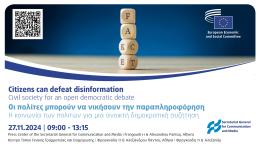
  • Civil society for an open democratic debate
    Event type
    Conference

    This conference in Athens is the third event on disinformation being hosted by the European Economic and Social Committee (EESC) as part of its ongoing project aiming to fight disinformation with the help of civil society.

  • The 14th meeting of the EU-Ukraine Civil Society Platform (CSP) took place on 15 December 2023. During the meeting, a debate focused on assessing the implementation of the European Commission's opinion and the state of play of the implementation of the EU-Ukraine Association Agreement.

    In addition, the CSP discussed the initiatives for Ukraine's green recovery, economic integration of Ukraine to the EU, as well as current challenges related to labour market.

    A joint declaration, prepared by both sides, was discussed and adopted.

  • The 11th meeting of the EU-Ukraine Civil Society Platform took place on 20 April 2022. During the meeting, an exchange between authorities and members of the civil society platform was held with special focus on the unprovoked and unilateral armed aggression initiated by the Russian Federation against Ukraine on its independent and sovereign territory. A joint declaration, prepared by both sides, was discussed and adopted.

  • The 8th meeting of the EU-Georgia Civil Society Platform (CSP) was convened on 13 December 2021 via a videoconference. 

  • Representatives of the European and Georgian Domestic Advisory Groups (DAGs), set up under the Trade and Sustainable Development Chapter of the Association Agreement between the European Union and Georgia, held their 6th joint meeting virtually on 2 December 2021. 

  • The meeting of the EU-Moldova Domestic Advisory Group will take place on 18 November 2021 via a video conference. Please click on the program tab to consult the topics on the agenda.

  • The 8th meeting of the EU-Georgia Domestic Advisory Group took place on 16 October 2021 via a video conference. Please click on the programme tab to consult the topics on the agenda.

  • The representatives of the two Domestic Advisory Groups (DAGs) from the EU and Ukraine held their fifth joint meeting via a videoconference on 22 October 2021. 

  • The 8th meeting of the EU-Moldova Civil Society Platform took place on 28 October 2021 in the format of a videoconference. During the meeting, a debate focused on assessing the state of play of the implementation of the EU-Moldova Association Agreement. The social dialogue and prospects for the future in Moldova were also discussed as well as the minimum wage mechanism. 

  • The 11th meeting of the EU Domestic Advisory Group under the EU-Ukraine DCFTA took place via a videoconference on 18 October 2021.