De østlige nabolande

This page is also available in:

EØSU's aktiviteter i forhold til nabolandene i øst vedrører Armenien, Aserbajdsjan, Hviderusland, Georgien, Moldova og Ukraine. EØSU's vigtigste opgave er her at skabe bedre forbindelser til civilsamfundsorganisationerne i regionen og inddrage dem i en dialog med både de nationale politiske beslutningstagere og EU's civilsamfundsorganisationer.

De vigtigste samarbejdsmekanismer med Georgien, Moldova og Ukraine er civilsamfundsplatformene, som supplerer de politiske organer, der findes inden for rammerne af EU's associeringsaftaler med de tre lande. Via platformene har civilsamfundsorganisationer i såvel EU som partnerlandene mulighed for at overvåge gennemførelsen og formulere anbefalinger til de relevante myndigheder.

På EU-siden består platformene af medlemmer fra EØSU og repræsentanter for større europæiske civilsamfundsnetværk. Partnerskabslandene er repræsenteret i platformene ved en lang række forskellige civilsamfundsorganisationer. Sammensætningen af platformene afspejler en ligelig repræsentation af alle interessegrupper (arbejdsgiverorganisationer, fagforeninger og andre interessegrupper).

I EØSU blev Opfølgningsudvalget for EU's nabolande i øst oprettet i 2004 netop med henblik på at varetage forbindelserne med civilsamfundet i nabolandene i øst. Opfølgningsudvalget holder som regel fire møder om året og medlemmerne deltager aktivt i aktiviteterne i østpartnerskabet, bl.a. de multilaterale platforme og civilsamfundsforummet.
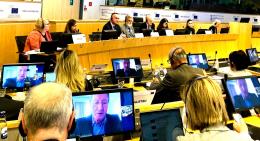
  • The External Relations Section (REX) of the European Economic and Social Committee (EESC) held a debate on 23 February 2026 to address the alarming deterioration of trade union freedoms in Belarus. Despite sustained international pressure and the appointment of an International Labour Organization (ILO) Special Envoy in June 2025, the Belarusian authorities continue to refuse any dialogue aimed at restoring compliance with fundamental labour standards. Around twenty trade unionists remain imprisoned.

  • On the occasion of the fifth anniversary of the ratification of the Enhanced Partnership and Cooperation Agreement (EPCA) between Kazakhstan and the EU, the European Economic and Social Committee (EESC) adopted at its March plenary session an action plan for enhancing cooperation between civil society organisations in the European Union and Kazakhstan. 

  • Civil society for an open democratic debate
    Event type
    Conference

    This conference in Lisbon is the fourth event on disinformation being hosted by the European Economic and Social Committee (EESC) as part of its ongoing project aiming to fight disinformation with the help of civil society.

  • Vedtaget on 17/07/2025 - Bureau decision date: 23/01/2025
    Reference
    REX/598-EESC-2025
    Plenary session number
    598
    -
    • Follow-up from the Commission REX/598
    Download format:
    Download — Udvalgets udtalelse: The importance of institutionalising civil and social dialogue in EU candidate and partner countries
  • The fifth meeting of the EU-Armenia Civil Society Platform (CSP) is scheduled to be held on 15 October 2024 in Brussels.

    The meeting will focus on assessing progress in the implementation of the EU-Armenia Comprehensive and Enhanced Partnership Agreement (CEPA), with a strong emphasis on its impact in the Areas of Democracy, Rule of Law, Anti-Corruption, and Human Rights.


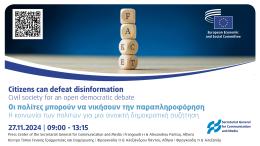
  • Civil society for an open democratic debate
    Event type
    Conference

    This conference in Athens is the third event on disinformation being hosted by the European Economic and Social Committee (EESC) as part of its ongoing project aiming to fight disinformation with the help of civil society.

  • The 14th meeting of the EU-Ukraine Civil Society Platform (CSP) took place on 15 December 2023. During the meeting, a debate focused on assessing the implementation of the European Commission's opinion and the state of play of the implementation of the EU-Ukraine Association Agreement.

    In addition, the CSP discussed the initiatives for Ukraine's green recovery, economic integration of Ukraine to the EU, as well as current challenges related to labour market.

    A joint declaration, prepared by both sides, was discussed and adopted.

  • Published in
    8 pages

    The External Relations Section (REX) of the European Economic and Social Committee (EESC) is responsible for dialogue between European civil society organisations and their homologues from the countries with which the European Union has formal relations (e.g. under the form of a Free Trade Agreement). Through this dialogue, made possible by a series of bilateral bodies, and through specialized opinions and information reports, the Committee is able to concretely contribute to EU foreign policy.

  • Document type
    Joint declaration
    Latest update
    • Joint declaration - 7th joint meeting of the EU-Moldova Domestic Advisory Groups
  • Vedtaget on 26/10/2022 - Bureau decision date: 20/09/2022
    Reference
    REX/564-EESC-2022
    Civil Society Organisations - GR III
    Download format:
    Download — Udvalgets udtalelse: Specific provisions for the 2014-2020 cooperation programmes supported by the European Neighbourhood Instrument and under the European territorial cooperation goal, following programme implementation disruption