Vecinii UE din est

This page is also available in:

Activitățile CESE cu privire la vecinii din est implică Armenia, Azerbaidjan, Belarus, Georgia, Moldova și Ucraina. Obiectivul principal al CESE cu privire la vecinii din Europa de Est este de a consolida relațiile cu organizațiile societății civile din regiune și de a le implica într-un dialog cu factorii de decizie la nivel național și cu societatea civilă organizată din UE.

Principalele mecanisme de cooperare cu Georgia, Moldova și Ucraina sunt platformele societății civile, care completează organismele politice existente în cadrul acordurilor de asociere ale UE cu aceste țări. Platformele permit organizațiilor societății civile atât din partea UE, cât și din partea țărilor partenere, să monitorizeze procesul de punere în aplicare și să-și elaboreze recomandările pentru autoritățile relevante.

Din partea UE, aceste platforme cuprind membri ai CESE și reprezentanți ai marilor rețele ale societății civile europene. Din partea țărilor partenere, acestea reprezintă un spectru larg de organizații ale societății civile. Calitatea de membru al platformelor se bazează pe o reprezentare echilibrată a tuturor grupurilor de interese (organizații ale angajatorilor, sindicate și diferite grupuri de interese).

În cadrul CESE, Comitetul de monitorizare pentru vecinii UE din est a fost înființat în 2004, ca organism specific responsabil pentru relațiile cu societatea civilă din țările din vecinătatea estică. Comitetul de monitorizare se reunește de obicei de patru ori pe an, iar membrii săi iau parte în mod activ la activitățile Parteneriatului estic, precum platformele multilaterale ale acestuia și Forumul societății civile din cadrul Parteneriatului estic.
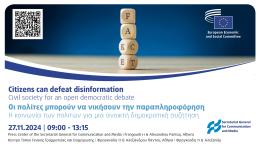
 

  • Civil society for an open democratic debate
    Event type
    Conference

    This conference in Athens is the third event on disinformation being hosted by the European Economic and Social Committee (EESC) as part of its ongoing project aiming to fight disinformation with the help of civil society.

  • The 14th meeting of the EU-Ukraine Civil Society Platform (CSP) took place on 15 December 2023. During the meeting, a debate focused on assessing the implementation of the European Commission's opinion and the state of play of the implementation of the EU-Ukraine Association Agreement.

    In addition, the CSP discussed the initiatives for Ukraine's green recovery, economic integration of Ukraine to the EU, as well as current challenges related to labour market.

    A joint declaration, prepared by both sides, was discussed and adopted.

  • The 11th meeting of the EU-Ukraine Civil Society Platform took place on 20 April 2022. During the meeting, an exchange between authorities and members of the civil society platform was held with special focus on the unprovoked and unilateral armed aggression initiated by the Russian Federation against Ukraine on its independent and sovereign territory. A joint declaration, prepared by both sides, was discussed and adopted.

  • The 8th meeting of the EU-Georgia Civil Society Platform (CSP) was convened on 13 December 2021 via a videoconference. 

  • Representatives of the European and Georgian Domestic Advisory Groups (DAGs), set up under the Trade and Sustainable Development Chapter of the Association Agreement between the European Union and Georgia, held their 6th joint meeting virtually on 2 December 2021. 

  • The meeting of the EU-Moldova Domestic Advisory Group will take place on 18 November 2021 via a video conference. Please click on the program tab to consult the topics on the agenda.

  • The 8th meeting of the EU-Georgia Domestic Advisory Group took place on 16 October 2021 via a video conference. Please click on the programme tab to consult the topics on the agenda.

  • The representatives of the two Domestic Advisory Groups (DAGs) from the EU and Ukraine held their fifth joint meeting via a videoconference on 22 October 2021. 

  • The 8th meeting of the EU-Moldova Civil Society Platform took place on 28 October 2021 in the format of a videoconference. During the meeting, a debate focused on assessing the state of play of the implementation of the EU-Moldova Association Agreement. The social dialogue and prospects for the future in Moldova were also discussed as well as the minimum wage mechanism. 

  • The 11th meeting of the EU Domestic Advisory Group under the EU-Ukraine DCFTA took place via a videoconference on 18 October 2021.