European Economic
and Social Committee
European Economic
and Social Committee
The European Economic and Social Committee (EESC) is the voice of organised civil society in Europe.
Find out more about its role and structure at http://www.eesc.europa.eu/en/about
The EESC issues between 160 and 190 opinions, evaluation and information reports a year.
It also organises several annual initiatives and events with a focus on civil society and citizens’ participation such as the Civil Society Prize, the Civil Society Days, the Your Europe, Your Say youth plenary and the ECI Day.
Find the latest EESC opinions and publications at http://www.eesc.europa.eu/en/our-work/opinions-information-reports/opinions and http://www.eesc.europa.eu/en/our-work/publications-other-work/publications respectively.
The EESC is active in a wide range of areas, from social affairs to economy, energy and sustainability.
Learn more about our policy areas and policy highlights at http://www.eesc.europa.eu/en/policies
The EESC holds nine plenary sessions per year. It also organises many conferences, public hearings and high-level debates related to its work.
Find out more about our upcoming events at http://www.eesc.europa.eu/en/agenda/our-events/upcoming-events
Here you can find news and information about the EESC'swork, including its social media accounts, the EESC Info newsletter, photo galleries and videos.
Read the latest EESC news http://www.eesc.europa.eu/en/news-media/news and press releases http://www.eesc.europa.eu/en/news-media/press-releases
The EESC brings together representatives from all areas of organised civil society, who give their independent advice on EU policies and legislation. The EESC's326 Members are organised into three groups: Employers, Workers and Various Interests.
Find out more about our Members and groups at http://www.eesc.europa.eu/en/members-groups
The EESC has six sections, specialising in concrete topics of relevance to the citizens of the European Union, ranging from social to economic affairs, energy, environment, external relations or the internal market.
Find out more at http://www.eesc.europa.eu/en/sections-other-bodies
Långsiktigt hållbara transporter är möjliga, men bara om individer, industrin och transportsektorn ställer sig bakom två mål: en minskning av transportsektorns utsläpp med 90 % fram till 2050 och ett åtagande om att använda de överenskomna metoderna och medlen för att nå slutresultatet.
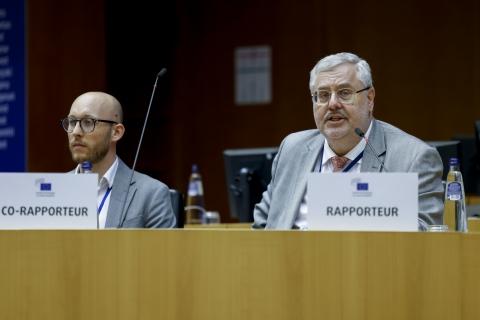
Det här är budskapet i ett EESK-yttrande som utarbetats av Stefan Back och Mateusz Szymański och som antogs vid plenarsession den 27 april 2023.
För att uppnå målet om långsiktigt miljövänliga transporter menade Stefan Back att ”omställningen måste vara attraktiv och realistisk, och därmed acceptabel för medborgarna och företagen i tre hänseenden: ekonomiskt, socialt och praktiskt”.
”Bara på så sätt kan omställningen få aktivt stöd från samhället – i annat fall finns det en risk inte bara för att omställningen misslyckas, utan i värsta fall för social oro”, tillade Mateusz Szymański.
EESK menar närmare bestämt att en rad villkor måste vara uppfyllda för att omställningen ska lyckas.
För det första måste företagen känna att de inte överbelastas med kostnader och att de kommer att behålla sin konkurrenskraft, inte bara inom utan också utanför EU.
För det andra måste arbetstagarna uppleva att omställningen är acceptabel och ges möjlighet att anpassa sig till nya arbetsvillkor på ett socialt godtagbart sätt.
För det tredje måste medborgarna, i såväl tätorter som landsbygdsområden, omfattas av tillgänglighet och ha tillgång till mobilitet till en rimlig kostnad och under goda allmänna förhållanden. (mp)