European Economic
and Social Committee
European Economic
and Social Committee
The European Economic and Social Committee (EESC) is the voice of organised civil society in Europe.
Find out more about its role and structure at http://www.eesc.europa.eu/en/about
The EESC issues between 160 and 190 opinions, evaluation and information reports a year.
It also organises several annual initiatives and events with a focus on civil society and citizens’ participation such as the Civil Society Prize, the Civil Society Days, the Your Europe, Your Say youth plenary and the ECI Day.
Find the latest EESC opinions and publications at http://www.eesc.europa.eu/en/our-work/opinions-information-reports/opinions and http://www.eesc.europa.eu/en/our-work/publications-other-work/publications respectively.
The EESC is active in a wide range of areas, from social affairs to economy, energy and sustainability.
Learn more about our policy areas and policy highlights at http://www.eesc.europa.eu/en/policies
The EESC holds nine plenary sessions per year. It also organises many conferences, public hearings and high-level debates related to its work.
Find out more about our upcoming events at http://www.eesc.europa.eu/en/agenda/our-events/upcoming-events
Here you can find news and information about the EESC'swork, including its social media accounts, the EESC Info newsletter, photo galleries and videos.
Read the latest EESC news http://www.eesc.europa.eu/en/news-media/news and press releases http://www.eesc.europa.eu/en/news-media/press-releases
The EESC brings together representatives from all areas of organised civil society, who give their independent advice on EU policies and legislation. The EESC's326 Members are organised into three groups: Employers, Workers and Various Interests.
Find out more about our Members and groups at http://www.eesc.europa.eu/en/members-groups
The EESC has six sections, specialising in concrete topics of relevance to the citizens of the European Union, ranging from social to economic affairs, energy, environment, external relations or the internal market.
Find out more at http://www.eesc.europa.eu/en/sections-other-bodies
Ein zukunftsfähiger Verkehr ist möglich, aber nur wenn die Bürger, die Wirtschaft und der Verkehrssektor zwei Ziele unterschreiben: eine Verringerung der Emissionen im Verkehrsbereich um 90 % bis 2050 verbunden mit der Zusage, dieses Endziel auf die vereinbarte Art und Weise und mit den vereinbarten Mitteln zu erreichen.
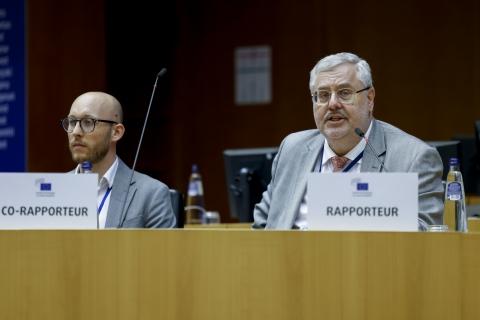
Das ist die Kernaussage der EWSA-Stellungnahme von Stefan Back und Mateusz Szymański, die auf der Plenartagung am 27. April 2023 verabschiedet wurde.
Zur Erreichung des Ziels eines langfristig grünen Verkehrs „muss die Umstellung attraktiv gestaltet und realistisch und somit für die Bürger und Unternehmen aus dreifacher Sicht – finanziell, sozial und praktisch – tragbar sein“, erklärte Stefan Back.
„Nur so wird die Umstellung auf aktive Unterstützung in unserer Gesellschaft stoßen, anderenfalls droht sie nicht nur zu scheitern, sondern kann schlimmstenfalls sogar zu sozialen Unruhen zu führen“, fügte Mateusz Szymański hinzu.
Insbesondere müssen aus Sicht des EWSA bestimmte Voraussetzungen erfüllt sein, damit der Übergang gelingen kann.
Zunächst müssen die Unternehmen das Gefühl haben, dass ihnen keine übermäßigen Kosten entstehen und sie wettbewerbsfähig bleiben, nicht nur innerhalb, sondern auch außerhalb der EU.
Zweitens müssen die Arbeitnehmer die Umstellung als vertretbar wahrnehmen und die Möglichkeit haben, sich auf sozialverträgliche Weise auf neue Arbeitsbedingungen einzustellen.
Drittens müssen Erreichbarkeit und Mobilität sowohl in Ballungsräumen als auch in ländlichen Gebieten für die Bürgerinnen und Bürger zu annehmbaren Kosten und unter guten allgemeinen Bedingungen gegeben sein. (mp)