European Economic
and Social Committee
European Economic
and Social Committee
The European Economic and Social Committee (EESC) is the voice of organised civil society in Europe.
Find out more about its role and structure at http://www.eesc.europa.eu/en/about
The EESC issues between 160 and 190 opinions, evaluation and information reports a year.
It also organises several annual initiatives and events with a focus on civil society and citizens’ participation such as the Civil Society Prize, the Civil Society Days, the Your Europe, Your Say youth plenary and the ECI Day.
Find the latest EESC opinions and publications at http://www.eesc.europa.eu/en/our-work/opinions-information-reports/opinions and http://www.eesc.europa.eu/en/our-work/publications-other-work/publications respectively.
The EESC is active in a wide range of areas, from social affairs to economy, energy and sustainability.
Learn more about our policy areas and policy highlights at http://www.eesc.europa.eu/en/policies
The EESC holds nine plenary sessions per year. It also organises many conferences, public hearings and high-level debates related to its work.
Find out more about our upcoming events at http://www.eesc.europa.eu/en/agenda/our-events/upcoming-events
Here you can find news and information about the EESC'swork, including its social media accounts, the EESC Info newsletter, photo galleries and videos.
Read the latest EESC news http://www.eesc.europa.eu/en/news-media/news and press releases http://www.eesc.europa.eu/en/news-media/press-releases
The EESC brings together representatives from all areas of organised civil society, who give their independent advice on EU policies and legislation. The EESC's326 Members are organised into three groups: Employers, Workers and Various Interests.
Find out more about our Members and groups at http://www.eesc.europa.eu/en/members-groups
The EESC has six sections, specialising in concrete topics of relevance to the citizens of the European Union, ranging from social to economic affairs, energy, environment, external relations or the internal market.
Find out more at http://www.eesc.europa.eu/en/sections-other-bodies
Long-term sustainable transport is possible, but only if people, industry and the transport sector buy into two objectives: a 90% emission reduction in the transport sector by 2050 and a commitment to using the agreed ways and means to get to the final result.
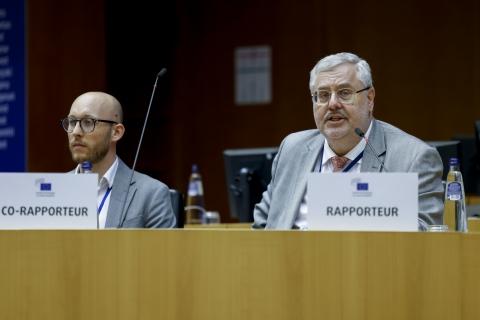
This was the message sent by the EESC opinion drafted by Stefan Back and Mateusz Szymański and adopted at the plenary session on 27 April 2023.
To achieve the objective of long-term green transport, "the transition must be attractive and realistic, and thus acceptable to citizens and businesses from three points of view: financial, social and practical," said Mr Back.
"That is the only way the transition can be actively supported by our society, otherwise the risk is not only failure, but at worst social unrest," added Mr Szymański.
More specifically, the EESC says that in order for the transition to succeed, certain conditions must be fulfilled.
First of all, businesses must feel that they are not overburdened with costs and that they will retain competitiveness, not only within but also outside the EU.
Secondly, employees must experience the transition as acceptable and be given the possibility to adapt to new working conditions in a socially acceptable manner.
Thirdly, citizens both in agglomerations and rural areas must benefit from accessibility and mobility at a reasonable cost and under good general conditions. (mp)