European Economic
and Social Committee
European Economic
and Social Committee
The European Economic and Social Committee (EESC) is the voice of organised civil society in Europe.
Find out more about its role and structure at http://www.eesc.europa.eu/en/about
The EESC issues between 160 and 190 opinions, evaluation and information reports a year.
It also organises several annual initiatives and events with a focus on civil society and citizens’ participation such as the Civil Society Prize, the Civil Society Days, the Your Europe, Your Say youth plenary and the ECI Day.
Find the latest EESC opinions and publications at http://www.eesc.europa.eu/en/our-work/opinions-information-reports/opinions and http://www.eesc.europa.eu/en/our-work/publications-other-work/publications respectively.
The EESC is active in a wide range of areas, from social affairs to economy, energy and sustainability.
Learn more about our policy areas and policy highlights at http://www.eesc.europa.eu/en/policies
The EESC holds nine plenary sessions per year. It also organises many conferences, public hearings and high-level debates related to its work.
Find out more about our upcoming events at http://www.eesc.europa.eu/en/agenda/our-events/upcoming-events
Here you can find news and information about the EESC'swork, including its social media accounts, the EESC Info newsletter, photo galleries and videos.
Read the latest EESC news http://www.eesc.europa.eu/en/news-media/news and press releases http://www.eesc.europa.eu/en/news-media/press-releases
The EESC brings together representatives from all areas of organised civil society, who give their independent advice on EU policies and legislation. The EESC's326 Members are organised into three groups: Employers, Workers and Various Interests.
Find out more about our Members and groups at http://www.eesc.europa.eu/en/members-groups
The EESC has six sections, specialising in concrete topics of relevance to the citizens of the European Union, ranging from social to economic affairs, energy, environment, external relations or the internal market.
Find out more at http://www.eesc.europa.eu/en/sections-other-bodies
Dolgoročno trajnostni promet je mogoč, vendar le, če si ljudje, industrija in prometni sektor prizadevajo za dva cilja: 90-odstotno zmanjšanje emisij v prometnem sektorju do leta 2050 in zavezo za uporabo dogovorjenih načinov in sredstev za dosego končnega rezultata.
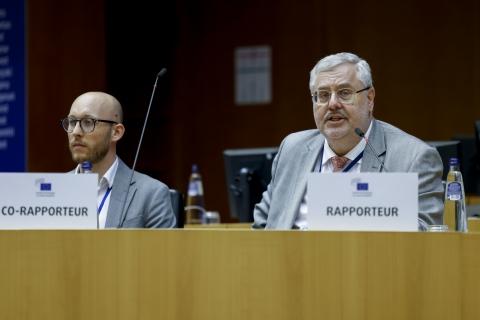
To je bilo sporočilo iz mnenja EESO, ki sta ga pripravila Stefan Back in Mateusz Szymański in je bilo sprejeto na plenarnem zasedanju 27. aprila 2023.
Da bi dosegli cilj dolgoročnega zelenega prometa, „mora biti prehod privlačen in realističen ter s tem sprejemljiv za državljane in podjetja s treh vidikov: finančnega, socialnega in praktičnega,“ je dejal g. Back.
„To je edini način, da naša družba dejavno podpre prehod, sicer tveganje ni samo neuspeh, temveč v najhujšem primeru družbeni nemiri,“ je dodal g. Szymański.
EESO poleg tega meni, da morajo biti za uspeh prehoda izpolnjeni nekateri pogoji.
Podjetja morajo predvsem čutiti, da niso preobremenjena s stroški in da bodo ohranila konkurenčnost, tako znotraj EU kot po svetu.
Poleg tega morajo zaposleni prehod doživljati kot sprejemljiv in imeti možnost, da se na socialno sprejemljiv način prilagodijo novim delovnim pogojem.
Predvsem pa je treba državljanom tako v aglomeracijah kot na podeželju zagotoviti dostop in mobilnost po razumni ceni in pod dobrimi splošnimi pogoji. (mp)