European Economic
and Social Committee
European Economic
and Social Committee
The European Economic and Social Committee (EESC) is the voice of organised civil society in Europe.
Find out more about its role and structure at http://www.eesc.europa.eu/en/about
The EESC issues between 160 and 190 opinions, evaluation and information reports a year.
It also organises several annual initiatives and events with a focus on civil society and citizens’ participation such as the Civil Society Prize, the Civil Society Days, the Your Europe, Your Say youth plenary and the ECI Day.
Find the latest EESC opinions and publications at http://www.eesc.europa.eu/en/our-work/opinions-information-reports/opinions and http://www.eesc.europa.eu/en/our-work/publications-other-work/publications respectively.
The EESC is active in a wide range of areas, from social affairs to economy, energy and sustainability.
Learn more about our policy areas and policy highlights at http://www.eesc.europa.eu/en/policies
The EESC holds nine plenary sessions per year. It also organises many conferences, public hearings and high-level debates related to its work.
Find out more about our upcoming events at http://www.eesc.europa.eu/en/agenda/our-events/upcoming-events
Here you can find news and information about the EESC'swork, including its social media accounts, the EESC Info newsletter, photo galleries and videos.
Read the latest EESC news http://www.eesc.europa.eu/en/news-media/news and press releases http://www.eesc.europa.eu/en/news-media/press-releases
The EESC brings together representatives from all areas of organised civil society, who give their independent advice on EU policies and legislation. The EESC's326 Members are organised into three groups: Employers, Workers and Various Interests.
Find out more about our Members and groups at http://www.eesc.europa.eu/en/members-groups
The EESC has six sections, specialising in concrete topics of relevance to the citizens of the European Union, ranging from social to economic affairs, energy, environment, external relations or the internal market.
Find out more at http://www.eesc.europa.eu/en/sections-other-bodies
Det kan godt lade sig gøre at opnå bæredygtig transport på længere sigt, men kun hvis borgerne, erhvervslivet og transportsektoren bakker om op to mål: at nedbringe CO2- udledningen i transportsektoren med 90 % frem mod 2050 og at forpligte sig til at anvende de aftalte metoder og midler til at nå dette mål.
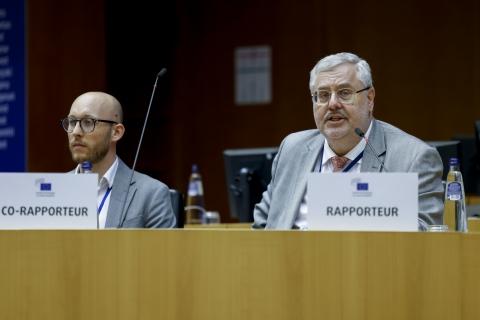
Sådan lød budskabet i den EØSU-udtalelse, som er udarbejdet af Stefan Back og Mateusz Szymański, og som blev vedtaget på plenarforsamlingen den 27. april 2023.
For at nå målet om miljøvenlig transport på længere sigt skal "omstillingen være attraktiv og realistisk og dermed acceptabel for borgerne og erhvervslivet i tre henseender: økonomisk, samfundsmæssigt og i praksis," sagde Stefan Back.
"Det er den eneste måde, hvorpå vi kan få samfundet til at støtte aktivt op om omstillingen. I modsat fald risikerer vi ikke blot fiasko, men i værste fald social uro", tilføjede Mateusz Szymański.
EØSU mener mere specifikt, at omstillingen kun vil lykkes, hvis visse betingelser er opfyldt:
For det første skal virksomhederne føle, at de ikke bliver overbebyrdet med omkostninger, og at de bevarer deres konkurrenceevne, ikke kun inden for, men også uden for EU.
For det andet skal arbejdstagerne opleve omstillingen som acceptabel og have mulighed for at omstille sig til nye arbejdsvilkår på en samfundsmæssig acceptabel måde.
For det tredje skal borgerne i både byområder og landdistrikter kunne nyde godt af tilgængelighed og mobilitet til en rimelig pris og på gode generelle vilkår. (mp)