European Economic
and Social Committee
European Economic
and Social Committee
The European Economic and Social Committee (EESC) is the voice of organised civil society in Europe.
Find out more about its role and structure at http://www.eesc.europa.eu/en/about
The EESC issues between 160 and 190 opinions, evaluation and information reports a year.
It also organises several annual initiatives and events with a focus on civil society and citizens’ participation such as the Civil Society Prize, the Civil Society Days, the Your Europe, Your Say youth plenary and the ECI Day.
Find the latest EESC opinions and publications at http://www.eesc.europa.eu/en/our-work/opinions-information-reports/opinions and http://www.eesc.europa.eu/en/our-work/publications-other-work/publications respectively.
The EESC is active in a wide range of areas, from social affairs to economy, energy and sustainability.
Learn more about our policy areas and policy highlights at http://www.eesc.europa.eu/en/policies
The EESC holds nine plenary sessions per year. It also organises many conferences, public hearings and high-level debates related to its work.
Find out more about our upcoming events at http://www.eesc.europa.eu/en/agenda/our-events/upcoming-events
Here you can find news and information about the EESC'swork, including its social media accounts, the EESC Info newsletter, photo galleries and videos.
Read the latest EESC news http://www.eesc.europa.eu/en/news-media/news and press releases http://www.eesc.europa.eu/en/news-media/press-releases
The EESC brings together representatives from all areas of organised civil society, who give their independent advice on EU policies and legislation. The EESC's326 Members are organised into three groups: Employers, Workers and Various Interests.
Find out more about our Members and groups at http://www.eesc.europa.eu/en/members-groups
The EESC has six sections, specialising in concrete topics of relevance to the citizens of the European Union, ranging from social to economic affairs, energy, environment, external relations or the internal market.
Find out more at http://www.eesc.europa.eu/en/sections-other-bodies
Duurzaam vervoer op lange termijn is mogelijk, maar alleen als de mensen, de industrie en de vervoerssector zich achter twee doelstellingen scharen: een emissiereductie van 90 % in de vervoerssector tegen 2050 en de toezegging dat zij de overeengekomen manieren en middelen gebruiken om het eindresultaat te bereiken.
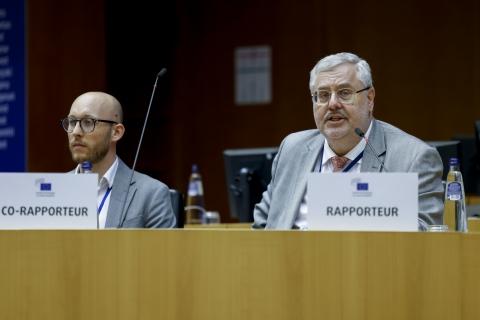
Dit is de boodschap in het EESC-advies van Stefan Back en Mateusz Szymański dat tijdens de zitting van 27 april 2023 is goedgekeurd.
Om de langetermijndoelstelling te bereiken, namelijk groen vervoer, "moet de transitie aantrekkelijk en realistisch zijn, en dus aanvaardbaar voor burgers en bedrijven vanuit drie oogpunten: financieel, sociaal en praktisch", aldus de heer Back.
"Dit is de enige manier waarop de samenleving de overstap actief kan ondersteunen, anders dreigt niet alleen mislukking, maar in het ergste geval sociale onrust", voegde de heer Szymanski hieraan toe.
In het bijzonder stelt het EESC dat aan bepaalde voorwaarden moet zijn voldaan, wil de transitie kans van slagen hebben.
In de eerste plaats moet het bedrijfsleven het gevoel hebben dat het niet met kosten wordt opgezadeld en dat het concurrentievermogen behouden blijft, zowel binnen als buiten de EU.
Ten tweede moeten werknemers de transitie als aanvaardbaar ervaren en de mogelijkheid krijgen om zich op een sociaal aanvaardbare manier aan de nieuwe arbeidsomstandigheden aan te passen.
Ten derde moeten burgers, zowel in steden als op het platteland, tegen redelijke kosten en onder goede algemene voorwaarden kunnen rekenen op toegankelijkheid en mobiliteit. (mp)