European Economic
and Social Committee
European Economic
and Social Committee
The European Economic and Social Committee (EESC) is the voice of organised civil society in Europe.
Find out more about its role and structure at http://www.eesc.europa.eu/en/about
The EESC issues between 160 and 190 opinions, evaluation and information reports a year.
It also organises several annual initiatives and events with a focus on civil society and citizens’ participation such as the Civil Society Prize, the Civil Society Days, the Your Europe, Your Say youth plenary and the ECI Day.
Find the latest EESC opinions and publications at http://www.eesc.europa.eu/en/our-work/opinions-information-reports/opinions and http://www.eesc.europa.eu/en/our-work/publications-other-work/publications respectively.
The EESC is active in a wide range of areas, from social affairs to economy, energy and sustainability.
Learn more about our policy areas and policy highlights at http://www.eesc.europa.eu/en/policies
The EESC holds nine plenary sessions per year. It also organises many conferences, public hearings and high-level debates related to its work.
Find out more about our upcoming events at http://www.eesc.europa.eu/en/agenda/our-events/upcoming-events
Here you can find news and information about the EESC'swork, including its social media accounts, the EESC Info newsletter, photo galleries and videos.
Read the latest EESC news http://www.eesc.europa.eu/en/news-media/news and press releases http://www.eesc.europa.eu/en/news-media/press-releases
The EESC brings together representatives from all areas of organised civil society, who give their independent advice on EU policies and legislation. The EESC's326 Members are organised into three groups: Employers, Workers and Various Interests.
Find out more about our Members and groups at http://www.eesc.europa.eu/en/members-groups
The EESC has six sections, specialising in concrete topics of relevance to the citizens of the European Union, ranging from social to economic affairs, energy, environment, external relations or the internal market.
Find out more at http://www.eesc.europa.eu/en/sections-other-bodies
Dugoročno održiv prijevoz je moguć, ali samo ako ljudi, industrija i prometni sektor sudjeluju u postizanju dvaju ciljeva: smanjenja emisija stakleničkih plinova od 90 % do 2050. i predanosti korištenju dogovorenih načina i sredstava za ostvarenje konačnog cilja.
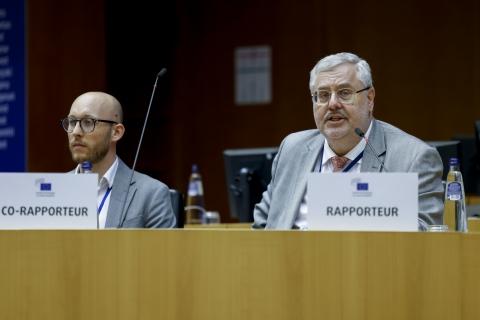
To je poruka iz mišljenja EGSO-a koje su izradili Stefan Back i Mateusz Szymański, a koje je usvojeno na plenarnom zasjedanju 27. travnja 2023.
Kako bi se postigao cilj dugoročno zelenog prijevoza, „prelazak mora biti privlačan i realističan te stoga prihvatljiv građanima i poduzećima iz tri perspektive: financijske, socijalne i praktične”, rekao je g. Back.
„To je jedini način na koji naše društvo može aktivno podupirati tranziciju, a u suprotnom postoji rizik ne samo od neuspjeha, nego i, u najgorem slučaju, od izbijanja društvenih nemira”, dodao je g. Szymański.
Konkretnije, EGSO smatra da za uspješnu tranziciju moraju biti ispunjeni određeni uvjeti.
Prvo, poduzeća moraju imati dojam da nisu opterećena prekomjernim troškovima i da će zadržati konkurentnost, i to ne samo u okviru EU-a, već i izvan njega.
Drugo, tranzicija mora biti prihvatljiva zaposlenicima i oni moraju imati mogućnost prilagodbe novim radnim uvjetima na društveno prihvatljiv način.
Treće, građani moraju imati koristi od pristupačnosti i mobilnosti uz razumne troškove i pod dobrim općim uvjetima, i u aglomeracijama i u ruralnim područjima. (mp)