European Economic
and Social Committee
European Economic
and Social Committee
The European Economic and Social Committee (EESC) is the voice of organised civil society in Europe.
Find out more about its role and structure at http://www.eesc.europa.eu/en/about
The EESC issues between 160 and 190 opinions, evaluation and information reports a year.
It also organises several annual initiatives and events with a focus on civil society and citizens’ participation such as the Civil Society Prize, the Civil Society Days, the Your Europe, Your Say youth plenary and the ECI Day.
Find the latest EESC opinions and publications at http://www.eesc.europa.eu/en/our-work/opinions-information-reports/opinions and http://www.eesc.europa.eu/en/our-work/publications-other-work/publications respectively.
The EESC is active in a wide range of areas, from social affairs to economy, energy and sustainability.
Learn more about our policy areas and policy highlights at http://www.eesc.europa.eu/en/policies
The EESC holds nine plenary sessions per year. It also organises many conferences, public hearings and high-level debates related to its work.
Find out more about our upcoming events at http://www.eesc.europa.eu/en/agenda/our-events/upcoming-events
Here you can find news and information about the EESC'swork, including its social media accounts, the EESC Info newsletter, photo galleries and videos.
Read the latest EESC news http://www.eesc.europa.eu/en/news-media/news and press releases http://www.eesc.europa.eu/en/news-media/press-releases
The EESC brings together representatives from all areas of organised civil society, who give their independent advice on EU policies and legislation. The EESC's326 Members are organised into three groups: Employers, Workers and Various Interests.
Find out more about our Members and groups at http://www.eesc.europa.eu/en/members-groups
The EESC has six sections, specialising in concrete topics of relevance to the citizens of the European Union, ranging from social to economic affairs, energy, environment, external relations or the internal market.
Find out more at http://www.eesc.europa.eu/en/sections-other-bodies
EHSV predložil súbor kľúčových odporúčaní v reakcii na navrhovaný legislatívny balík Komisie týkajúci sa reformy rámca správy hospodárskych záležitostí Európskej únie. Hoci EHSV oceňuje zámer zjednodušiť rámec, zasadzuje sa za zásadné úpravy návrhu. Tieto odporúčania prichádzajú v rozhodujúcej chvíli a zdôrazňujú potrebu vyváženého, adaptabilného a udržateľného prístupu k správe hospodárskych záležitostí v rámci EÚ.
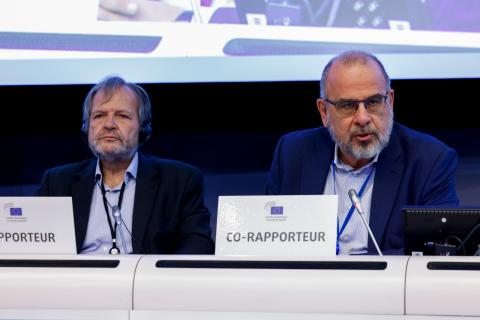
Uprostred výziev, ktorým EÚ čelí, ako sú pandémia, zložitá geopolitická situácia a klimatické ciele, sa spravodajca EHSV Javier Doz Orrit zasadzuje za flexibilnejšie fiškálne a štrukturálne plány, do ktorých budú zapojené národné demokratické inštitúcie a občianska spoločnosť, a navrhuje vytvoriť stálu fiškálnu kapacitu pre EÚ a dôkladnejšiu správu hospodárskych záležitostí. Hoci EHSV oceňuje niektoré aspekty legislatívneho balíka, požaduje zásadné úpravy.
Spoluspravodajca Luca Jahier naliehavo žiada okamžité rokovania o vyváženom a vynútiteľnom hospodárskom rámci. Medzi kľúčové návrhy patrí nahradenie prísnych pravidiel na zníženie deficitu cielenejším prístupom, prehodnotenie automatických sankcií a udelenie možnosti vládam členských štátov vyjadriť sa k fiškálnym plánom. EHSV takisto navrhuje, aby sa investície v oblasti zelenej transformácie a obrany posudzovali odlišne, aby sa rozšírila definícia verejných investícií a vytvorila fiškálna kapacita EÚ do roku 2026. Zdôrazňuje sa potreba inkluzívnej správy počas celého procesu, do ktorej sú zapojení sociálni partneri, občianska spoločnosť a parlamenty.