European Economic
and Social Committee
European Economic
and Social Committee
The European Economic and Social Committee (EESC) is the voice of organised civil society in Europe.
Find out more about its role and structure at http://www.eesc.europa.eu/en/about
The EESC issues between 160 and 190 opinions, evaluation and information reports a year.
It also organises several annual initiatives and events with a focus on civil society and citizens’ participation such as the Civil Society Prize, the Civil Society Days, the Your Europe, Your Say youth plenary and the ECI Day.
Find the latest EESC opinions and publications at http://www.eesc.europa.eu/en/our-work/opinions-information-reports/opinions and http://www.eesc.europa.eu/en/our-work/publications-other-work/publications respectively.
The EESC is active in a wide range of areas, from social affairs to economy, energy and sustainability.
Learn more about our policy areas and policy highlights at http://www.eesc.europa.eu/en/policies
The EESC holds nine plenary sessions per year. It also organises many conferences, public hearings and high-level debates related to its work.
Find out more about our upcoming events at http://www.eesc.europa.eu/en/agenda/our-events/upcoming-events
Here you can find news and information about the EESC'swork, including its social media accounts, the EESC Info newsletter, photo galleries and videos.
Read the latest EESC news http://www.eesc.europa.eu/en/news-media/news and press releases http://www.eesc.europa.eu/en/news-media/press-releases
The EESC brings together representatives from all areas of organised civil society, who give their independent advice on EU policies and legislation. The EESC's326 Members are organised into three groups: Employers, Workers and Various Interests.
Find out more about our Members and groups at http://www.eesc.europa.eu/en/members-groups
The EESC has six sections, specialising in concrete topics of relevance to the citizens of the European Union, ranging from social to economic affairs, energy, environment, external relations or the internal market.
Find out more at http://www.eesc.europa.eu/en/sections-other-bodies
EESK har lagt fram en rad centrala rekommendationer som svar på kommissionens förslag till lagstiftningspaket om en reform av EU:s ramverk för ekonomisk styrning EESK uppskattar avsikten att förenkla ramverket, men vill se vissa viktiga justeringar av förslaget. Dessa rekommendationer kommer vid en kritisk tidpunkt och understryker behovet av en balanserad, anpassningsbar och hållbar strategi för ekonomisk styrning inom EU.
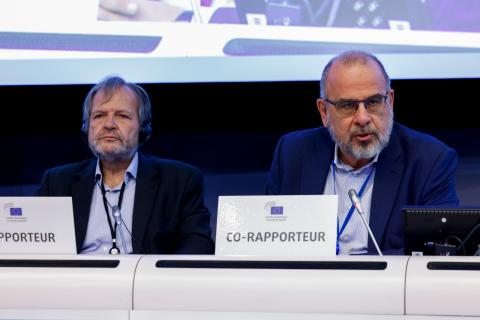
Mot bakgrund av de utmaningar som EU har ställts inför, t.ex. pandemin, den besvärliga geopolitiska situationen och klimatmålen, förespråkar EESK:s föredragande Javier Doz Orrit mer flexibla finans- och strukturpolitiska planer som involverar demokratiska institutioner och det civila samhället i medlemsstaterna, med en permanent finanspolitisk kapacitet för EU och en fördjupad ekonomisk styrning. EESK uppskattar vissa delar av lagstiftningspaketet men förespråkar betydande justeringar.
Medföredraganden Luca Jahier vill se omedelbara förhandlingar med målet att uppnå en balanserad och bättre verkställbar ekonomisk ram. Till de viktigaste förslagen hör att ersätta stelbenta regler för att minska underskott med en mer skräddarsydd strategi, ompröva automatiska sanktioner och ge de nationella regeringarna inflytande över de finanspolitiska planerna. EESK föreslår också att gröna investeringar och försvarsinvesteringar behandlas olika, att definitionen av offentliga investeringar utvidgas och att EU:s finanspolitiska kapacitet blir verklighet senast 2026. Betoningen bör ligga på en inkluderande styrning med deltagande av arbetsmarknadens parter, det civila samhället och parlamenten under hela processen.