
European Economic
and Social Committee
European Economic
and Social Committee
The European Economic and Social Committee (EESC) is the voice of organised civil society in Europe.
Find out more about its role and structure at http://www.eesc.europa.eu/en/about
The EESC issues between 160 and 190 opinions, evaluation and information reports a year.
It also organises several annual initiatives and events with a focus on civil society and citizens’ participation such as the Civil Society Prize, the Civil Society Days, the Your Europe, Your Say youth plenary and the ECI Day.
Find the latest EESC opinions and publications at http://www.eesc.europa.eu/en/our-work/opinions-information-reports/opinions and http://www.eesc.europa.eu/en/our-work/publications-other-work/publications respectively.
The EESC is active in a wide range of areas, from social affairs to economy, energy and sustainability.
Learn more about our policy areas and policy highlights at http://www.eesc.europa.eu/en/policies
The EESC holds nine plenary sessions per year. It also organises many conferences, public hearings and high-level debates related to its work.
Find out more about our upcoming events at http://www.eesc.europa.eu/en/agenda/our-events/upcoming-events
Here you can find news and information about the EESC'swork, including its social media accounts, the EESC Info newsletter, photo galleries and videos.
Read the latest EESC news http://www.eesc.europa.eu/en/news-media/news and press releases http://www.eesc.europa.eu/en/news-media/press-releases
The EESC brings together representatives from all areas of organised civil society, who give their independent advice on EU policies and legislation. The EESC's326 Members are organised into three groups: Employers, Workers and Various Interests.
Find out more about our Members and groups at http://www.eesc.europa.eu/en/members-groups
The EESC has six sections, specialising in concrete topics of relevance to the citizens of the European Union, ranging from social to economic affairs, energy, environment, external relations or the internal market.
Find out more at http://www.eesc.europa.eu/en/sections-other-bodies
Der EWSA hat als Antwort auf das Gesetzespaket der Kommission zur Reform der wirtschaftspolitischen Steuerung der EU eine Reihe entscheidender Empfehlungen vorgelegt. Darin begrüßt der EWSA die Bestrebungen zur Vereinfachung des Steuerungsrahmens, plädiert aber auch für maßgebliche Änderungen. Diese Empfehlungen kommen zu einem entscheidenden Zeitpunkt, braucht die EU doch gerade jetzt eine ausgewogene, anpassungsfähige und nachhaltige wirtschaftspolitische Steuerung.
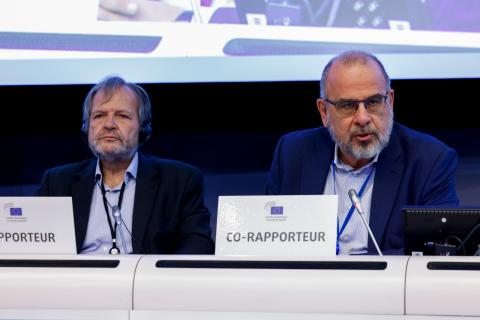
Angesichts der Herausforderungen für die EU wie die Pandemie, geopolitische Problemlagen und Klimaziele spricht sich EWSA-Berichterstatter Javier Doz Orrit für flexiblere Haushalts- und Strukturpläne unter Einbeziehung der nationalen demokratischen Institutionen und der Zivilgesellschaft aus. Er empfiehlt eine ständige Fiskalkapazität der EU und eine vertiefte wirtschaftspolitische Steuerung. Der EWSA begrüßt zwar bestimmte Aspekte des Legislativpakets, fordert aber auch maßgebliche Änderungen.
Ko-Berichterstatter Luca Jahier dringt auf rasche Verhandlungen für einen ausgewogenen und durchsetzbaren wirtschaftlichen Rahmen. Zu den wichtigsten Vorschlägen gehören das Abrücken von starren Vorschriften für den Defizitabbau durch einen maßgeschneiderten Ansatz, die Überprüfung automatischer Sanktionen und die Gewährung eines Mitspracherechts für die nationalen Regierungen bei den Haushaltsplanungen. Der EWSA schlägt ferner vor, grüne Investitionen und Verteidigungsinvestitionen bei der Defizitberechnung auszunehmen, die Definition öffentlicher Investitionen auszuweiten und bis 2026 eine Fiskalkapazität der EU zu schaffen. Wichtig ist eine inklusive Governance unter Einbeziehung der Sozialpartner, der Zivilgesellschaft und der Parlamente über den gesamten Zyklus.