European Economic
and Social Committee
European Economic
and Social Committee
The European Economic and Social Committee (EESC) is the voice of organised civil society in Europe.
Find out more about its role and structure at http://www.eesc.europa.eu/en/about
The EESC issues between 160 and 190 opinions, evaluation and information reports a year.
It also organises several annual initiatives and events with a focus on civil society and citizens’ participation such as the Civil Society Prize, the Civil Society Days, the Your Europe, Your Say youth plenary and the ECI Day.
Find the latest EESC opinions and publications at http://www.eesc.europa.eu/en/our-work/opinions-information-reports/opinions and http://www.eesc.europa.eu/en/our-work/publications-other-work/publications respectively.
The EESC is active in a wide range of areas, from social affairs to economy, energy and sustainability.
Learn more about our policy areas and policy highlights at http://www.eesc.europa.eu/en/policies
The EESC holds nine plenary sessions per year. It also organises many conferences, public hearings and high-level debates related to its work.
Find out more about our upcoming events at http://www.eesc.europa.eu/en/agenda/our-events/upcoming-events
Here you can find news and information about the EESC'swork, including its social media accounts, the EESC Info newsletter, photo galleries and videos.
Read the latest EESC news http://www.eesc.europa.eu/en/news-media/news and press releases http://www.eesc.europa.eu/en/news-media/press-releases
The EESC brings together representatives from all areas of organised civil society, who give their independent advice on EU policies and legislation. The EESC's326 Members are organised into three groups: Employers, Workers and Various Interests.
Find out more about our Members and groups at http://www.eesc.europa.eu/en/members-groups
The EESC has six sections, specialising in concrete topics of relevance to the citizens of the European Union, ranging from social to economic affairs, energy, environment, external relations or the internal market.
Find out more at http://www.eesc.europa.eu/en/sections-other-bodies
O CESE apresentou um conjunto de recomendações fundamentais em resposta ao pacote legislativo proposto pela Comissão Europeia em matéria de reforma do quadro de governação económica da União Europeia. Embora acolha com agrado a intenção de simplificar o quadro, o CESE defende alterações a alguns pontos críticos da proposta. Estas recomendações surgem num momento crucial e sublinham a necessidade de uma abordagem equilibrada, adaptável e sustentável da governação económica na UE.
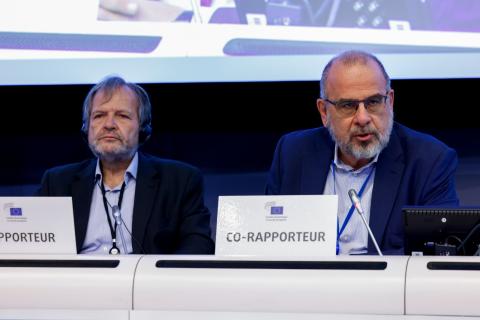
Num contexto marcado por desafios à escala da UE, tais como a pandemia, a complexa situação geopolítica e os objetivos climáticos, o relator do CESE, Javier Doz Orrit, defende planos orçamentais e estruturais mais flexíveis, com a participação das instituições democráticas nacionais e da sociedade civil, e recomenda o estabelecimento de uma capacidade orçamental permanente da UE e o aprofundamento da governação económica. Embora acolha com agrado determinados aspetos do pacote legislativo, o CESE defende alterações substanciais à proposta.
O correlator, Luca Jahier, apela para negociações imediatas com vista a um quadro económico equilibrado e aplicável. As principais propostas passam por substituir as regras rígidas de redução do défice por uma abordagem mais adaptada, reapreciar o mecanismo de sanções automáticas e permitir que os governos nacionais tenham uma palavra a dizer nos planos orçamentais. O CESE propõe igualmente um tratamento diferente para os investimentos nos domínios da transição ecológica e da defesa, o alargamento da definição de investimento público e o estabelecimento de uma capacidade orçamental da UE até 2026. Por último, sublinha a importância de uma governação inclusiva, que assegure a participação dos parceiros sociais, da sociedade civil e dos parlamentos nacionais em todas as fases do processo.