European Economic
and Social Committee
European Economic
and Social Committee
The European Economic and Social Committee (EESC) is the voice of organised civil society in Europe.
Find out more about its role and structure at http://www.eesc.europa.eu/en/about
The EESC issues between 160 and 190 opinions, evaluation and information reports a year.
It also organises several annual initiatives and events with a focus on civil society and citizens’ participation such as the Civil Society Prize, the Civil Society Days, the Your Europe, Your Say youth plenary and the ECI Day.
Find the latest EESC opinions and publications at http://www.eesc.europa.eu/en/our-work/opinions-information-reports/opinions and http://www.eesc.europa.eu/en/our-work/publications-other-work/publications respectively.
The EESC is active in a wide range of areas, from social affairs to economy, energy and sustainability.
Learn more about our policy areas and policy highlights at http://www.eesc.europa.eu/en/policies
The EESC holds nine plenary sessions per year. It also organises many conferences, public hearings and high-level debates related to its work.
Find out more about our upcoming events at http://www.eesc.europa.eu/en/agenda/our-events/upcoming-events
Here you can find news and information about the EESC'swork, including its social media accounts, the EESC Info newsletter, photo galleries and videos.
Read the latest EESC news http://www.eesc.europa.eu/en/news-media/news and press releases http://www.eesc.europa.eu/en/news-media/press-releases
The EESC brings together representatives from all areas of organised civil society, who give their independent advice on EU policies and legislation. The EESC's326 Members are organised into three groups: Employers, Workers and Various Interests.
Find out more about our Members and groups at http://www.eesc.europa.eu/en/members-groups
The EESC has six sections, specialising in concrete topics of relevance to the citizens of the European Union, ranging from social to economic affairs, energy, environment, external relations or the internal market.
Find out more at http://www.eesc.europa.eu/en/sections-other-bodies
EØSU har fremlagt en række afgørende anbefalinger som reaktion på Kommissionens foreslåede lovgivningspakke om en reform af EU's ramme for økonomisk styring. EØSU værdsætter hensigten om at forenkle rammen, men mener også, at der bør foretages vigtige justeringer af forslaget. Disse anbefalinger kommer på et afgørende tidspunkt og understreger behovet for en afbalanceret, fleksibel og bæredygtig tilgang til økonomisk styring i EU.
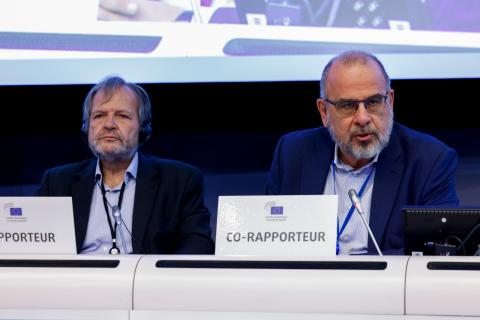
I en tid, hvor EU står over for udfordringer som pandemien, de komplekse geopolitiske forhold og klimamålene, slår EØSU's ordfører Javier Doz Orrit til lyd for mere fleksible finanspolitiske og strukturelle planer med inddragelse af nationale demokratiske institutioner og civilsamfundet og foreslår, at der indføres en permanent finanspolitisk kapacitet for EU og øget økonomisk styring. EØSU værdsætter visse aspekter af lovgivningspakken, men opfordrer til væsentlige tilpasninger.
Medordfører Luca Jahier opfordrer kraftigt til, at der straks indledes forhandlinger om en afbalanceret økonomisk ramme, der kan håndhæves. De vigtigste forslag går ud på at erstatte stramme regler for nedbringelse af underskud med en mere skræddersyet tilgang, genoverveje automatiske sanktioner og give de nationale regeringer indflydelse på de finanspolitiske planer. EØSU foreslår desuden, at grønne investeringer og investeringer på forsvarsområdet behandles forskelligt, at definitionen af offentlige investeringer udvides, og at der etableres en finanspolitisk kapacitet i EU inden 2026. Inklusiv forvaltning med inddragelse af arbejdsmarkedets parter, civilsamfundet og parlamenter bør fremhæves i hele processen.