European Economic
and Social Committee
European Economic
and Social Committee
The European Economic and Social Committee (EESC) is the voice of organised civil society in Europe.
Find out more about its role and structure at http://www.eesc.europa.eu/en/about
The EESC issues between 160 and 190 opinions, evaluation and information reports a year.
It also organises several annual initiatives and events with a focus on civil society and citizens’ participation such as the Civil Society Prize, the Civil Society Days, the Your Europe, Your Say youth plenary and the ECI Day.
Find the latest EESC opinions and publications at http://www.eesc.europa.eu/en/our-work/opinions-information-reports/opinions and http://www.eesc.europa.eu/en/our-work/publications-other-work/publications respectively.
The EESC is active in a wide range of areas, from social affairs to economy, energy and sustainability.
Learn more about our policy areas and policy highlights at http://www.eesc.europa.eu/en/policies
The EESC holds nine plenary sessions per year. It also organises many conferences, public hearings and high-level debates related to its work.
Find out more about our upcoming events at http://www.eesc.europa.eu/en/agenda/our-events/upcoming-events
Here you can find news and information about the EESC'swork, including its social media accounts, the EESC Info newsletter, photo galleries and videos.
Read the latest EESC news http://www.eesc.europa.eu/en/news-media/news and press releases http://www.eesc.europa.eu/en/news-media/press-releases
The EESC brings together representatives from all areas of organised civil society, who give their independent advice on EU policies and legislation. The EESC's326 Members are organised into three groups: Employers, Workers and Various Interests.
Find out more about our Members and groups at http://www.eesc.europa.eu/en/members-groups
The EESC has six sections, specialising in concrete topics of relevance to the citizens of the European Union, ranging from social to economic affairs, energy, environment, external relations or the internal market.
Find out more at http://www.eesc.europa.eu/en/sections-other-bodies
El CESE ha presentado una serie de recomendaciones fundamentales en respuesta al paquete legislativo propuesto por la Comisión para reformar el marco de gobernanza económica de la Unión Europea. Si bien el CESE valora positivamente la intención de simplificar dicho marco, aboga por introducir ajustes críticos en la propuesta. La formulación de estas recomendaciones se produce en un momento crucial, lo que subraya la necesidad de adoptar un enfoque equilibrado, adaptable y sostenible de la gobernanza económica en la UE.
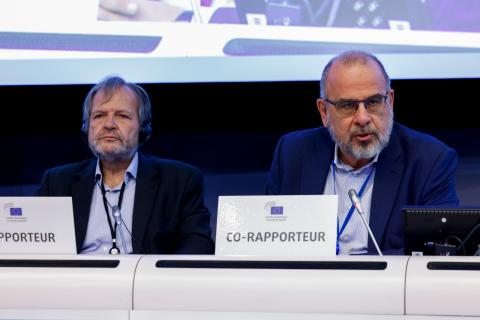
Con la Unión asediada por retos como la pandemia, las complejidades geopolíticas y los objetivos climáticos, Javier Doz Orrit, ponente del CESE, aboga por el establecimiento de planes presupuestarios y estructurales más flexibles en los que participen las instituciones democráticas nacionales y la sociedad civil, y propone crear una capacidad presupuestaria permanente de la UE y una gobernanza económica más profunda. Si bien el CESE valora positivamente algunos aspectos del paquete legislativo, pide introducir ajustes críticos.
El coponente Luca Jahier insta a que se inicien rápidamente las negociaciones para crear un marco económico equilibrado y ejecutable. Entre las principales propuestas figuran sustituir la rígida normativa en materia de reducción del déficit por un planteamiento más adaptado, reconsiderar si la imposición de sanciones debe ser automática y otorgar a los Gobiernos nacionales poder de decisión sobre los planes presupuestarios. Además, el CESE propone dar un trato diferente a las inversiones ecológicas y de defensa, ampliar la definición de inversión pública y crear una capacidad fiscal de la UE a más tardar en 2026. Durante todo el proceso se hace hincapié en una gobernanza inclusiva en la que participen los interlocutores sociales, la sociedad civil y los parlamentos.