European Economic
and Social Committee
European Economic
and Social Committee
The European Economic and Social Committee (EESC) is the voice of organised civil society in Europe.
Find out more about its role and structure at http://www.eesc.europa.eu/en/about
The EESC issues between 160 and 190 opinions, evaluation and information reports a year.
It also organises several annual initiatives and events with a focus on civil society and citizens’ participation such as the Civil Society Prize, the Civil Society Days, the Your Europe, Your Say youth plenary and the ECI Day.
Find the latest EESC opinions and publications at http://www.eesc.europa.eu/en/our-work/opinions-information-reports/opinions and http://www.eesc.europa.eu/en/our-work/publications-other-work/publications respectively.
The EESC is active in a wide range of areas, from social affairs to economy, energy and sustainability.
Learn more about our policy areas and policy highlights at http://www.eesc.europa.eu/en/policies
The EESC holds nine plenary sessions per year. It also organises many conferences, public hearings and high-level debates related to its work.
Find out more about our upcoming events at http://www.eesc.europa.eu/en/agenda/our-events/upcoming-events
Here you can find news and information about the EESC'swork, including its social media accounts, the EESC Info newsletter, photo galleries and videos.
Read the latest EESC news http://www.eesc.europa.eu/en/news-media/news and press releases http://www.eesc.europa.eu/en/news-media/press-releases
The EESC brings together representatives from all areas of organised civil society, who give their independent advice on EU policies and legislation. The EESC's326 Members are organised into three groups: Employers, Workers and Various Interests.
Find out more about our Members and groups at http://www.eesc.europa.eu/en/members-groups
The EESC has six sections, specialising in concrete topics of relevance to the citizens of the European Union, ranging from social to economic affairs, energy, environment, external relations or the internal market.
Find out more at http://www.eesc.europa.eu/en/sections-other-bodies
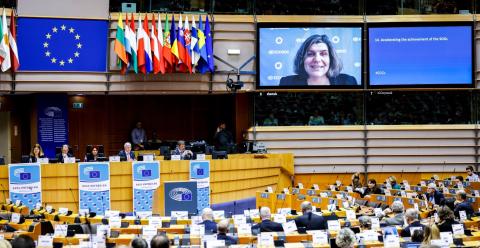
Predsedníčka Hospodárskej a sociálnej rady Organizácie Spojených národov sa na marcovom plenárnom zasadnutí EHSV vyslovila za to, aby občianska spoločnosť zohrávala poprednú úlohu pri vykonávaní Agendy 2030.
Veľvyslankyňa Lačezara Stoeva, predsedníčka Hospodárskej a sociálnej rady OSN, uviedla, že aktéri občianskej spoločnosti sú nenahraditeľnými spojencami pri plnení cieľov udržateľného rozvoja.
Predsedníčka EHSV Christa Schweng pri tejto príležitosti vyhlásila: „Musíme byť ambiciózni. Globálne výzvy si vyžadujú rázne globálne odpovede“. „Občianska spoločnosť by mala byť prizvaná na septembrový samit o cieľoch udržateľného rozvoja a jej zapojenie by malo byť štruktúrovanejšie a konkrétnejšie,“ dodala.
Veľvyslankyňa OSN Lačezara Stoeva jej slová potvrdila: „Bez občianskej spoločnosti nič nedosiahneme. Európska občianska spoločnosť často zohrávala vedúcu úlohu pri úvahách o budúcnosti. Keďže EHSV zastupuje mnohoraké zainteresované strany, dokáže svojím príspevkom meniť verejné politiky na vyváženejšie, spravodlivejšie a reaktívnejšie.“
EHSV aktívne prispel k prvému dobrovoľnému preskúmaniu vykonávania cieľov udržateľného rozvoja EÚ ako celku, ktoré bude predstavené na politickom fóre na vysokej úrovni v júli. Výbor predovšetkým vypracoval „modelový“ príspevok občianskej spoločnosti, ktorý by sa mohol využiť ako osvedčený postup pre iné regióny na celom svete. (mt)