European Economic
and Social Committee
European Economic
and Social Committee
The European Economic and Social Committee (EESC) is the voice of organised civil society in Europe.
Find out more about its role and structure at http://www.eesc.europa.eu/en/about
The EESC issues between 160 and 190 opinions, evaluation and information reports a year.
It also organises several annual initiatives and events with a focus on civil society and citizens’ participation such as the Civil Society Prize, the Civil Society Days, the Your Europe, Your Say youth plenary and the ECI Day.
Find the latest EESC opinions and publications at http://www.eesc.europa.eu/en/our-work/opinions-information-reports/opinions and http://www.eesc.europa.eu/en/our-work/publications-other-work/publications respectively.
The EESC is active in a wide range of areas, from social affairs to economy, energy and sustainability.
Learn more about our policy areas and policy highlights at http://www.eesc.europa.eu/en/policies
The EESC holds nine plenary sessions per year. It also organises many conferences, public hearings and high-level debates related to its work.
Find out more about our upcoming events at http://www.eesc.europa.eu/en/agenda/our-events/upcoming-events
Here you can find news and information about the EESC'swork, including its social media accounts, the EESC Info newsletter, photo galleries and videos.
Read the latest EESC news http://www.eesc.europa.eu/en/news-media/news and press releases http://www.eesc.europa.eu/en/news-media/press-releases
The EESC brings together representatives from all areas of organised civil society, who give their independent advice on EU policies and legislation. The EESC's326 Members are organised into three groups: Employers, Workers and Various Interests.
Find out more about our Members and groups at http://www.eesc.europa.eu/en/members-groups
The EESC has six sections, specialising in concrete topics of relevance to the citizens of the European Union, ranging from social to economic affairs, energy, environment, external relations or the internal market.
Find out more at http://www.eesc.europa.eu/en/sections-other-bodies
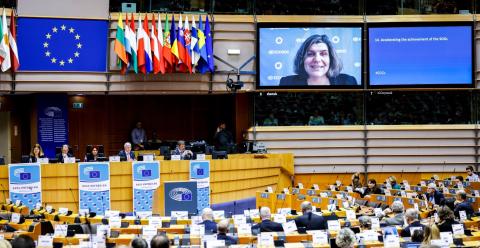
Luând cuvântul în cadrul sesiunii plenare a CESE din martie, președintele Consiliului Economic și Social al Organizației Națiunilor Unite (ECOSOC) a pledat pentru un rol important al societății civile în punerea în aplicare a Agendei 2030.
Ambasadoarea Lachezara Stoeva, președinta ECOSOC al ONU, a afirmat că actorii societății civile sunt aliați indispensabili pentru îndeplinirea obiectivelor de dezvoltare durabilă.
„Trebuie să fim ambițioși; provocările globale impun răspunsuri globale puternice”, a spus președinta Christa Schweng. Societatea civilă ar trebui să se așeze la masa summitului din septembrie consacrat ODD, iar implicarea sa ar trebui să fie mai structurată și mai concretă”, a adăugat ea.
Ambasadoarea ONU Lachezara Stoeva a afirmat: „Nu putem face nimic fără societatea civilă. Societatea civilă europeană a jucat adesea un rol de lider în gândirea orientată spre viitor. CESE, prin natura sa multipartită, are capacitatea de a contribui la politicile publice și de a le face mai echilibrate, echitabile și capabile să ofere răspunsuri adecvate”.
CESE a contribuit activ la prima revizuire voluntară globală de către UE a punerii în aplicare a ODD, care va fi prezentată la Forumul politic la nivel înalt pentru dezvoltare durabilă din iulie. În special, contribuția Comitetului în calitate de reprezentant al societății civile a reprezentat un „model” care ar putea fi utilizat ca bună practică pentru alte regiuni din întreaga lume. (mt)