European Economic
and Social Committee
European Economic
and Social Committee
The European Economic and Social Committee (EESC) is the voice of organised civil society in Europe.
Find out more about its role and structure at http://www.eesc.europa.eu/en/about
The EESC issues between 160 and 190 opinions, evaluation and information reports a year.
It also organises several annual initiatives and events with a focus on civil society and citizens’ participation such as the Civil Society Prize, the Civil Society Days, the Your Europe, Your Say youth plenary and the ECI Day.
Find the latest EESC opinions and publications at http://www.eesc.europa.eu/en/our-work/opinions-information-reports/opinions and http://www.eesc.europa.eu/en/our-work/publications-other-work/publications respectively.
The EESC is active in a wide range of areas, from social affairs to economy, energy and sustainability.
Learn more about our policy areas and policy highlights at http://www.eesc.europa.eu/en/policies
The EESC holds nine plenary sessions per year. It also organises many conferences, public hearings and high-level debates related to its work.
Find out more about our upcoming events at http://www.eesc.europa.eu/en/agenda/our-events/upcoming-events
Here you can find news and information about the EESC'swork, including its social media accounts, the EESC Info newsletter, photo galleries and videos.
Read the latest EESC news http://www.eesc.europa.eu/en/news-media/news and press releases http://www.eesc.europa.eu/en/news-media/press-releases
The EESC brings together representatives from all areas of organised civil society, who give their independent advice on EU policies and legislation. The EESC's326 Members are organised into three groups: Employers, Workers and Various Interests.
Find out more about our Members and groups at http://www.eesc.europa.eu/en/members-groups
The EESC has six sections, specialising in concrete topics of relevance to the citizens of the European Union, ranging from social to economic affairs, energy, environment, external relations or the internal market.
Find out more at http://www.eesc.europa.eu/en/sections-other-bodies
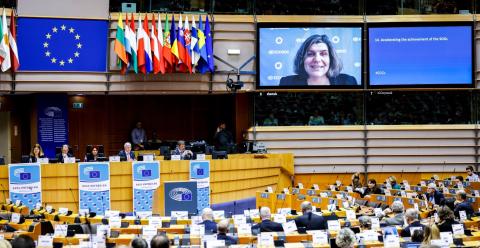
Die Präsidentin des Wirtschafts- und Sozialrates der Vereinten Nationen (ECOSOC) sprach sich auf der Plenartagung des EWSA im März für eine starke Rolle der Zivilgesellschaft bei der Umsetzung der Agenda 2030 aus.
Botschafterin Lachezara Stoeva, Präsidentin des ECOSOC der Vereinten Nationen, machte deutlich, dass zivilgesellschaftliche Akteure unverzichtbare Partner bei der Umsetzung der Nachhaltigkeitsziele (Sustainable Development Goals – SDG) sind.
„Wir müssen uns hohe Ziele setzen; globale Herausforderungen erfordern entschiedene globale Antworten“, erklärte EWSA-Präsidentin Christa Schweng. „Die Zivilgesellschaft sollte beim Nachhaltigkeitsgipfel im September am Verhandlungstisch vertreten sein. Sie muss strukturierter und konkreter eingebunden werden“, fügte sie hinzu.
Lachezara Stoeva, Botschafterin bei den Vereinten Nationen, führte aus: „Ohne die Zivilgesellschaft können wir nichts erreichen. Die europäische Zivilgesellschaft hat beim zukunftsgerichteten Denken oft eine Vorreiterrolle übernommen. Als Einrichtung, in der viele verschiedene Interessenträger vertreten sind, kann der EWSA einen Beitrag dazu leisten und für eine ausgewogenere, gerechtere und bedarfsorientiertere öffentliche Politik sorgen.“
Der EWSA hat einen aktiven Beitrag zum ersten freiwilligen Überprüfungsbericht der EU über die Umsetzung der Nachhaltigkeitsziele geleistet, der beim hochrangigen politischen Forum im Juli vorgelegt wird. Insbesondere hat der Ausschuss als Sprachrohr der Zivilgesellschaft einen beispielhaften Beitrag geleistet, der anderen Regionen der Welt als Vorbild dienen könnte. (mt)