European Economic
and Social Committee
European Economic
and Social Committee
The European Economic and Social Committee (EESC) is the voice of organised civil society in Europe.
Find out more about its role and structure at http://www.eesc.europa.eu/en/about
The EESC issues between 160 and 190 opinions, evaluation and information reports a year.
It also organises several annual initiatives and events with a focus on civil society and citizens’ participation such as the Civil Society Prize, the Civil Society Days, the Your Europe, Your Say youth plenary and the ECI Day.
Find the latest EESC opinions and publications at http://www.eesc.europa.eu/en/our-work/opinions-information-reports/opinions and http://www.eesc.europa.eu/en/our-work/publications-other-work/publications respectively.
The EESC is active in a wide range of areas, from social affairs to economy, energy and sustainability.
Learn more about our policy areas and policy highlights at http://www.eesc.europa.eu/en/policies
The EESC holds nine plenary sessions per year. It also organises many conferences, public hearings and high-level debates related to its work.
Find out more about our upcoming events at http://www.eesc.europa.eu/en/agenda/our-events/upcoming-events
Here you can find news and information about the EESC'swork, including its social media accounts, the EESC Info newsletter, photo galleries and videos.
Read the latest EESC news http://www.eesc.europa.eu/en/news-media/news and press releases http://www.eesc.europa.eu/en/news-media/press-releases
The EESC brings together representatives from all areas of organised civil society, who give their independent advice on EU policies and legislation. The EESC's326 Members are organised into three groups: Employers, Workers and Various Interests.
Find out more about our Members and groups at http://www.eesc.europa.eu/en/members-groups
The EESC has six sections, specialising in concrete topics of relevance to the citizens of the European Union, ranging from social to economic affairs, energy, environment, external relations or the internal market.
Find out more at http://www.eesc.europa.eu/en/sections-other-bodies
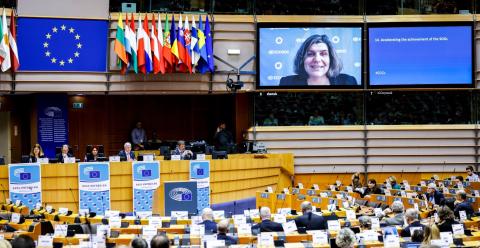
Predsjednica Gospodarskog i socijalnog vijeća Ujedinjenih naroda (ECOSOC) zagovarala je na plenarnom zasjedanju EGSO-a u ožujku snažnu ulogu civilnog društva u provedbi Programa održivog razvoja do 2030.
Veleposlanica Lachezara Stoeva, predsjednica ECOSOC-a, rekla je da su dionici iz civilnog društva ključni saveznici u provedbi ciljeva održivog razvoja.
„Moramo biti ambiciozni, a globalni izazovi iziskuju snažan globalni odgovor”, rekla je predsjednica EGSO-a Christa Schweng i dodala da bi „civilno društvo trebalo sudjelovati na samitu o ciljevima održivog razvoja koji će se održati u rujnu” i da bi trebalo biti uključeno „na strukturiraniji i konkretniji način”.
Veleposlanica UN-a Lachezara Stoeva kazala je: „Bez civilnog društva ne možemo ništa. Europsko civilno društvo često ima vodeću ulogu u razmišljanju usmjerenom na budućnost. EGSO, koji po svojoj prirodi surađuje s mnogo dionika, može dati svoj doprinos i politike učiniti uravnoteženijima, pravičnijima i prilagođenijima.”
EGSO je aktivno doprinio prvom dobrovoljnom pregledu EU-a, koji će biti predstavljen na političkom forumu na visokoj razini u srpnju. Konkretno, Odbor je osmislio „model” doprinosa civilnog društva koji bi se mogao koristiti kao primjer najbolje prakse za druge regije diljem svijeta. (mt)