European Economic
and Social Committee
European Economic
and Social Committee
The European Economic and Social Committee (EESC) is the voice of organised civil society in Europe.
Find out more about its role and structure at http://www.eesc.europa.eu/en/about
The EESC issues between 160 and 190 opinions, evaluation and information reports a year.
It also organises several annual initiatives and events with a focus on civil society and citizens’ participation such as the Civil Society Prize, the Civil Society Days, the Your Europe, Your Say youth plenary and the ECI Day.
Find the latest EESC opinions and publications at http://www.eesc.europa.eu/en/our-work/opinions-information-reports/opinions and http://www.eesc.europa.eu/en/our-work/publications-other-work/publications respectively.
The EESC is active in a wide range of areas, from social affairs to economy, energy and sustainability.
Learn more about our policy areas and policy highlights at http://www.eesc.europa.eu/en/policies
The EESC holds nine plenary sessions per year. It also organises many conferences, public hearings and high-level debates related to its work.
Find out more about our upcoming events at http://www.eesc.europa.eu/en/agenda/our-events/upcoming-events
Here you can find news and information about the EESC'swork, including its social media accounts, the EESC Info newsletter, photo galleries and videos.
Read the latest EESC news http://www.eesc.europa.eu/en/news-media/news and press releases http://www.eesc.europa.eu/en/news-media/press-releases
The EESC brings together representatives from all areas of organised civil society, who give their independent advice on EU policies and legislation. The EESC's326 Members are organised into three groups: Employers, Workers and Various Interests.
Find out more about our Members and groups at http://www.eesc.europa.eu/en/members-groups
The EESC has six sections, specialising in concrete topics of relevance to the citizens of the European Union, ranging from social to economic affairs, energy, environment, external relations or the internal market.
Find out more at http://www.eesc.europa.eu/en/sections-other-bodies
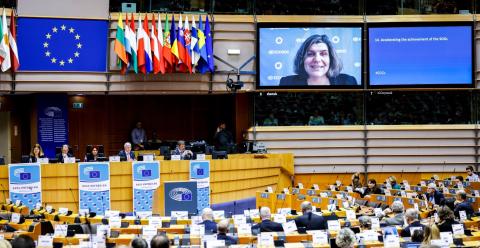
Waqt li tkellmet fis-sessjoni plenarja ta’ Marzu tal-KESE, il-President tal-Kunsill Ekonomiku u Soċjali tan-Nazzjonijiet Uniti (ECOSOC) irrakkomandat rwol b’saħħtu għas-soċjetà ċivili fl-implimentazzjoni tal-Aġenda 2030.
L-Ambaxxatriċi Lachezara Stoeva, President tal-ECOSOC tan-NU, qalet li l-atturi tas-soċjetà ċivili huma alleati indispensabbli sabiex jimplimentaw l-Għanijiet ta’ Żvilupp Sostenibbli.
“Irridu nkunu ambizzjużi; l-isfidi globali jeħtieġu risposti globali”, qalet il-President tal-KESE Christa Schweng. Hija żiedet tgħid li “Is-soċjetà ċivili għandu jkollha post mal-mejda waqt is-Summit tal-Għanijiet ta’ Żvilupp Sostenibbli ta’ Settembru, b’involviment aktar strutturat u konkret”.
L-Ambaxxatriċi tan-NU Lachezara Stoeva qalet: “Ma nistgħu nagħmlu xejn mingħajr is-soċjetà ċivili. Is-soċjetà ċivili Ewropea ta’ spiss kellha rwol ta’ tmexxija fil-ħsieb li jħares ’il quddiem. Il-KESE, bin-natura tiegħu ta’ diversi partijiet interessati, għandu l-kapaċità lli jikkontribwixxi u jagħmel il-politiki pubbliċi aktar bbilanċjati, ekwi u reattivi”.
Il-KESE kkontribwixxa b’mod attiv għall-ewwel Rieżami Volontarji globali tal-UE, li ser jiġi ppreżentat waqt il-Forum Politiku ta’ Livell Għoli f’Lulju. B’mod partikolari, il-Kumitat qed jipproduċi kontribut “mudell” tas-soċjetà ċivili, li jista’ jintuża bħala l-aħjar prattika għal reġjuni oħra madwar id-dinja. (mt)