European Economic
and Social Committee
European Economic
and Social Committee
The European Economic and Social Committee (EESC) is the voice of organised civil society in Europe.
Find out more about its role and structure at http://www.eesc.europa.eu/en/about
The EESC issues between 160 and 190 opinions, evaluation and information reports a year.
It also organises several annual initiatives and events with a focus on civil society and citizens’ participation such as the Civil Society Prize, the Civil Society Days, the Your Europe, Your Say youth plenary and the ECI Day.
Find the latest EESC opinions and publications at http://www.eesc.europa.eu/en/our-work/opinions-information-reports/opinions and http://www.eesc.europa.eu/en/our-work/publications-other-work/publications respectively.
The EESC is active in a wide range of areas, from social affairs to economy, energy and sustainability.
Learn more about our policy areas and policy highlights at http://www.eesc.europa.eu/en/policies
The EESC holds nine plenary sessions per year. It also organises many conferences, public hearings and high-level debates related to its work.
Find out more about our upcoming events at http://www.eesc.europa.eu/en/agenda/our-events/upcoming-events
Here you can find news and information about the EESC'swork, including its social media accounts, the EESC Info newsletter, photo galleries and videos.
Read the latest EESC news http://www.eesc.europa.eu/en/news-media/news and press releases http://www.eesc.europa.eu/en/news-media/press-releases
The EESC brings together representatives from all areas of organised civil society, who give their independent advice on EU policies and legislation. The EESC's326 Members are organised into three groups: Employers, Workers and Various Interests.
Find out more about our Members and groups at http://www.eesc.europa.eu/en/members-groups
The EESC has six sections, specialising in concrete topics of relevance to the citizens of the European Union, ranging from social to economic affairs, energy, environment, external relations or the internal market.
Find out more at http://www.eesc.europa.eu/en/sections-other-bodies
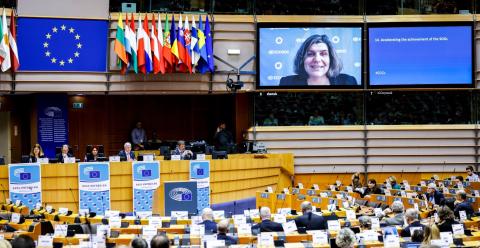
Predsednica Ekonomskega in socialnega sveta Združenih narodov (ECOSOC) se je v govoru na plenarnem zasedanju EESO marca zavzela za močno vlogo civilne družbe pri izvajanju Agende 2030.
Veleposlanica Lachezara Stoeva, predsednica ECOSOC ZN, je dejala, da so akterji civilne družbe nepogrešljivi zavezniki pri uresničevanju ciljev trajnostnega razvoja.
Predsednica EESO Christa Schweng pa je dejala: „Biti moramo ambiciozni, saj globalni izzivi zahtevajo odločne globalne odgovore. Civilna družba bi morala sodelovati na septembrskem vrhu o ciljih trajnostnega razvoja in biti bolj strukturno ter konkretno vključena,“ je še dodala.
Veleposlanica Stoeva pa je dodala: „Brez civilne družbe ne moremo ničesar. V Evropi ima pogosto vodilno vlogo pri razmišljanju, usmerjenemu v prihodnost, EESO pa lahko s svojo večdeležniško strukturo prispeva k temu, da bodo politike bolj uravnotežene, pravične in odzivne.“
EESO je aktivno sodeloval pri prvem prostovoljnem pregledu EU, ki bo predstavljen na političnem forumu na visoki ravni julija. Pripravil je „model“ prispevka civilne družbe, ki bi se lahko uporabljal kot primer dobre prakse za druge regije po svetu. (mt)