European Economic
and Social Committee
European Economic
and Social Committee
The European Economic and Social Committee (EESC) is the voice of organised civil society in Europe.
Find out more about its role and structure at http://www.eesc.europa.eu/en/about
The EESC issues between 160 and 190 opinions, evaluation and information reports a year.
It also organises several annual initiatives and events with a focus on civil society and citizens’ participation such as the Civil Society Prize, the Civil Society Days, the Your Europe, Your Say youth plenary and the ECI Day.
Find the latest EESC opinions and publications at http://www.eesc.europa.eu/en/our-work/opinions-information-reports/opinions and http://www.eesc.europa.eu/en/our-work/publications-other-work/publications respectively.
The EESC is active in a wide range of areas, from social affairs to economy, energy and sustainability.
Learn more about our policy areas and policy highlights at http://www.eesc.europa.eu/en/policies
The EESC holds nine plenary sessions per year. It also organises many conferences, public hearings and high-level debates related to its work.
Find out more about our upcoming events at http://www.eesc.europa.eu/en/agenda/our-events/upcoming-events
Here you can find news and information about the EESC'swork, including its social media accounts, the EESC Info newsletter, photo galleries and videos.
Read the latest EESC news http://www.eesc.europa.eu/en/news-media/news and press releases http://www.eesc.europa.eu/en/news-media/press-releases
The EESC brings together representatives from all areas of organised civil society, who give their independent advice on EU policies and legislation. The EESC's326 Members are organised into three groups: Employers, Workers and Various Interests.
Find out more about our Members and groups at http://www.eesc.europa.eu/en/members-groups
The EESC has six sections, specialising in concrete topics of relevance to the citizens of the European Union, ranging from social to economic affairs, energy, environment, external relations or the internal market.
Find out more at http://www.eesc.europa.eu/en/sections-other-bodies
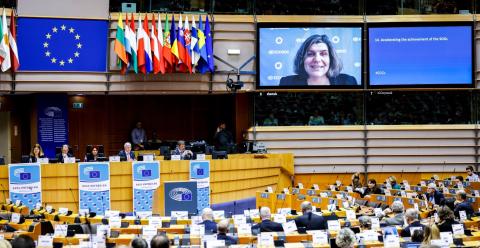
På EØSU's plenarforsamling i marts slog formanden for FN's Økonomiske og Sociale Råd (Ecosoc) til lyd for, at civilsamfundet tildeles en stor rolle i gennemførelsen af 2030-dagsordenen.
Ambassadør Lachezara Stoeva, der er formand for Ecosoc, sagde, at civilsamfundets aktører er uundværlige allierede ved gennemførelsen af verdensmålene.
"Vi er nødt til at være ambitiøse - de globale udfordringer kræver effektive globale løsninger", sagde EØSU's formand Christa Schweng. "Civilsamfundet bør være med ved bordet på topmødet om verdensmålene i september og inddrages på en mere struktureret og konkret måde", tilføjede hun.
FN-ambassadør Lachezara Stoeva sagde: "Vi kan ikke gøre noget uden civilsamfundet. Det europæiske civilsamfund er ofte gået forrest med nytænkning. EØSU har med sine mange interessenter mulighed for at bidrage til, at de offentlige politikker bliver mere velafbalancerede, rimelige og lydhøre".
EØSU har aktivt bidraget til EU's første samlede frivillige revision, der vil blive præsenteret på Det Politiske Forum på Højt Niveau i juli. EØSU har navnlig udarbejdet en model for civilsamfundets bidrag, som kan anvendes som bedste praksis af andre regioner rundt om i verden. (mt)