The 25th meeting of the EU-Colombia/Peru/Ecuador Domestic Advisory Group held on 20 April 2026 focused on the political, social and labour situation in the Andean region alongside the implementation of the EU trade agreement. Participants highlighted a deteriorating context marked by political instability, security concerns and persistent human rights and labour rights violations, as well as broader issues such as environmental degradation and the impact of drug trafficking.
The second meeting of the EU Domestic Advisory Group (DAG) under the EU–Kenya Economic Partnership Agreement (EPA), held on 13 April 2026 at the European Economic and Social Committee, brought together representatives from EU institutions, civil society, and international organisations to assess progress and discuss key priorities for implementation.
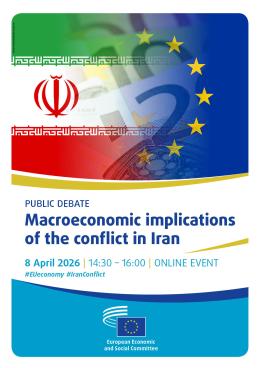
Public Debate | 8 April 2026 | 14:30-16:00 | Online Event Rising tensions and the renewed conflict in Iran adds new volatility to an already fragile global economic environment. Against a backdrop of geopolitical fragmentation, energy market uncertainty and slowing growth, understanding the macroeconomic implications of this conflict for Europe has become increasingly urgent. The Section for Economic and Monetary Union and Economic and Social Cohesion (ECO) of the EESC will organise a public debate to examine the broader macroeconomic consequences of the conflict in Iran for the European economy.
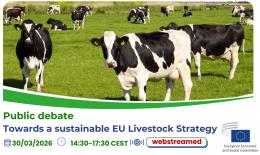
On 30 March 2026, the EESC Permanent Group on Sustainable Food Systems (PG) will hold a public debate “Towards a sustainable EU Livestock Strategy”, with the aim to contribute to the European Commission’s upcoming EU Livestock Strategy.
The EU–Serbia Joint Consultative Committee (JCC) met in Brussels on 30 March 2026 to discuss key developments in EU–Serbia relations, with a particular focus on the rule of law, judicial and electoral reforms, transparency and anti-corruption, democratic institutions, the operational challenges of the EU Entry-Exit System, and the state of social and civil dialogue.
Between 26 and 29 March 2026, EESC members joined the EU delegation at the 14th Ministerial Conference of the World Trade Organisation (WTO) in Yaoundé.
The delegation attended the daily debriefings for civil society hosted by DG Trade, and had informal meetings with the African Union ECOSOCC, the WTO, the French business association AFEP and the International Trade Union Confederation (ITUC). A short impromptu meeting was also organized with MEP Warborn (INTA).
Conference preceded by a joint meeting between the EESC Workers' Group and the S&D Group in the EP
Location
Rue Belliard 99, 1040 Brussels
Brussels
Belgium
The meeting will focus on the impact of geopolitical instability on workers' rights and labour markets in the EU and the impact of increasing defence budgets on welfare state, social security systems and workers' rights.
The EU-Central America DAG convened for its 30th meeting on 23 March 2026, chaired by WIDE+ (GR III). The agenda included briefings on the implementation of the Political Dialogue and Cooperation parts of the Association Agreement, exchanges with the representatives from the EEAS, DG INTPA and DG Trade on the implementation of recommendations from the latest Joint Declaration of the EU-CA DAGs. The Group also prepared for the upcoming Joint Events with Central American counterparts from Costa Rica, El Salvador, Guatemala, Honduras, Nicaragua, and Panama, scheduled for 15-17 June 2026 in Brussels.