Energy poverty remains a major concern for European people. Recent legislation has attempted to protect vulnerable consumers from electricity disconnection. This year, the European Commission has issued an action plan for affordable energy as part the Clean Industrial Deal, which focuses on decreasing energy prices for citizens, businesses and communities across the EU. This plan proposes a series of measures to lower energy bills and fast-track cost-saving and reinforcing structural reforms for our energy system.
EESC, Rue Van Maerlant/Van Maerlantstraat 2, 1040 Brussels
Brussels and online
Belgium
The EU Charter of Fundamental Rights, proclaimed 25 years ago in December 2000, plays a crucial role in upholding fundamental rights, democracy, and the rule of law across the Member States. To facilitate the effective implementation and application of the Charter, in 2020, the European Commission presented its “Strategy to strengthen the application of the Charter of Fundamental Rights in the EU”. This year, the Commission is undertaking a mid-term review of its strategy to strengthen the application of the Charter.
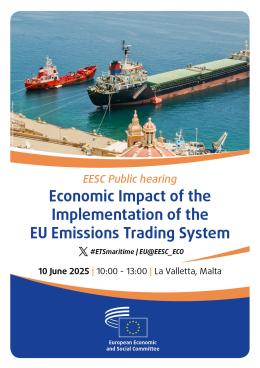
The European Economic and Social Committee (EESC) is organising a public hearing to assess the economic impact of extending the EU Emissions Trading System (ETS) to the maritime sector.
The hearing will focus on the risks of carbon and business leakage, and how these developments may affect port competitiveness and trade flows- particularly in smaller and peripheral EU Member States. The event will provide a platform for maritime stakeholders, economic experts, and EU institutions to discuss real-world implications and explore fiscal and strategic solutions to mitigate negative effects.
Speakers will include representatives from DG CLIMA, maritime and port organisations, as well as leading economists and policy analysts.
Malta’s strategic location and role in European maritime logistics make it an ideal setting for this timely discussion.
Economic and Social Council of Spain,
c/ Huertas, 73
Madrid
Spain
The 20th meeting of the EU-China Round Table took place in Madrid, Spain on 9 and 10 June 2025.
The EU-China Civil Society Round Table was established in 2007 following a decision taken by the 9th EU-China Summit in Helsinki. The delegations from the EESC and its Chinese counterpart, the China Economic and Social Council, meet regularly to discuss topics relating to economic and social issues relevant to both parties.
By elaborating reports, discussing them and exchanging ideas, the representatives of the European Economic and Social Committee and the China Economic and Social Council contribute to the development of the overall EU-China relationship, from a civil society perspective.
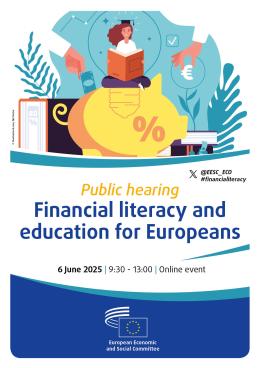
The EESC organises a public hearing on Financial literacy and education for Europeans. It will gather together institutions, industry and civil society stakeholders, and will discuss desirable policy actions and share good practices along the EU.
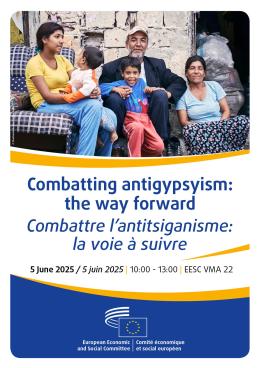
Surveys keep reporting high rates of discrimination experienced by members of the Roma community in view of their Roma origin. Long history of discrimination and negative perceptions towards the Roma community further entrench prejudicial practices and antigypsyistic sentiments, manifesting themselves in various contexts. Focussing on various policy areas, this hearing will look at institutional antigypsyism and discuss ways how this can be tackled effectively.
In a context such as the one that Europe is experiencing, characterised by multiple crises, it is appropriate to promote a reflection on European public goods and on fundamental political priorities capable of ensuring the sustainable growth of the EU and the well-being of its citizens. This reflection gets ever more important in view of the upcoming negotiations on the next European Multiannual Financial Framework for the period post 2027.
Rue Van Maerlant/Van Maerlantstraat 2, 1040 Bruxelles/Brussel
Brussels
Belgium
Persistent labour market inequalities across Europe affect women, young people and vulnerable groups, including persons with disabilities. Entrepreneurship holds significant potential to address these disparities by empowering individuals, fostering innovation and generating economic growth that benefits society as a whole. This hearing will bring together experts and stakeholders to identify common challenges, share good practices and propose policy solutions to foster equality and social inclusion through entrepreneurship.
Teatro Thalia, Estrada das Laranjeiras 205, Lisboa 1600-134
Lisbon
Portugal
This conference in Lisbon is the fourth event on disinformation being hosted by the European Economic and Social Committee (EESC) as part of its ongoing project aiming to fight disinformation with the help of civil society.