Uitbreidingslanden

This page is also available in:

Het EESC is actief betrokken bij het uitbreidingsproces van de EU en heeft een tweeledige aanpak ontwikkeld – regionaal en bilateraal – voor zijn betrekkingen met organisaties van het maatschappelijk middenveld in de uitbreidingslanden.

Met betrekking tot de regionale benadering is het follow-upcomité Westelijke Balkan – een permanent intern orgaan van het EESC – het belangrijkste instrument voor het coördineren van de activiteiten van het EESC in deze regio. Het forum voor het maatschappelijk middenveld van de Westelijke Balkan, dat om de twee jaar wordt georganiseerd, maakt deel uit van de werkzaamheden van het follow-upcomité.

Het EESC werkt ook bilateraal samen met landen van de Westelijke Balkan en Turkije. Op basis van de associatieovereenkomsten tussen deze landen en de EU, om de organisaties van het maatschappelijk middenveld te betrekken bij de pretoetredings- en toetredingsprocessen, heeft het EESC drie gemeenschappelijke organen gecreëerd met vertegenwoordigers van het maatschappelijk middenveld – met Turkije, Montenegro en Servië. Elk orgaan bestaat uit een gelijk aantal leden van het EESC en van het partnerland en komt tweemaal per jaar samen.

Het EESC onderhoudt regelmatige contacten en organiseert gezamenlijke activiteiten met de organisaties van het maatschappelijk middenveld van uitbreidingslanden waarmee nog geen gemeenschappelijk orgaan voor vertegenwoordigers van het maatschappelijk middenveld is opgericht.

De werkzaamheden van de gemeenschappelijke organen worden aangevuld met de voorbereiding van EESC-adviezen over de pretoetredings- en toetredingsprocessen van de afzonderlijke landen, alsmede over onderwerpen van regionaal belang.
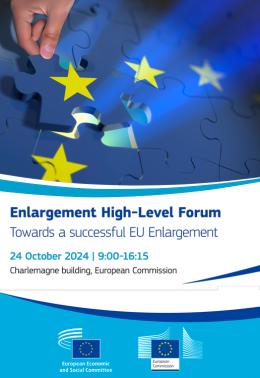
  • Towards a successful EU Enlargment

    On 24 th October, the EESC will welcome some 100 Enlargement Candidate Members (ECMs) in the Enlargement High-Level Forum "Towards  successful EU Enlargement" jointly organised with the European Commission back-to-back to Plenary. 

  • Civil society for an open democratic debate

    This is the 2nd campaign on fighting disinformation that the European Economic and Social Committee (EESC) is organising as part of its overall project on disinformation to be implemented with the help of civil society.

  • Connecting EU 2022
    -

    The EESC's annual seminar for civil society communicators zoomed in on the impact of the war in Ukraine on the EU, addressing three thorny issues.

  • Event type
    JCC Meeting

    For the 8th time, the European Economic and Social Committee (EESC) and Montenegro held the Civil Society Joint Consultative Committee (JCC) in Budva, Montenegro.

    This meeting tackled following issues: Assessment of the state of play in Montenegro accession negotiations to the EU, Chapter 28 of the accession negotiations – with focus on Consumer protection and Debate on the situation of young people on the labour market.

  • Event type
    JCC Meeting
  • Published in
    16 pages

    Europe is facing a pivotal moment. Social and economic inequalities, rapid technological change, anti-democratic forces and geopolitical instability are straining the foundations of the European project.

    With democracy and civic space under mounting pressure, civil society organisations, human rights defenders and free media face growing constraints - from restrictive laws and disinformation campaigns to underfunding and public distrust. Deepening polarisation and eroding trust in institutions further undermine Europe’s democratic model.

  • Published in
    13 pages

    The European Economic and Social Committee (EESC) on 19 June 2025 adopted a resolution to provide the European Commission with a contribution to its 2026 work programme.

  • Published in
    8 pages

    2025 Civil Society Week conclusions

  • Published in
    8 pages

    This resolution presents recommendations of the European Economic and Social Committee to the legislature 2024-2029. They are based on discussions with social partners and civil society organizations from all walks of life, including young people during the first EESC Civil Society Week, and contain a comprehensive set of actionable steps to strengthen and safeguard democratic principles.

  • Published in
    15 pages

    This document seeks to provide input to the Global Coalition for Social Justice. It highlights key messages from EESC opinions on the six priority areas identified by the International Labour Organization (ILO) for immediate action.