Países de la ampliación

This page is also available in:

El CESE participa activamente en el proceso de ampliación de la UE y ha desarrollado un enfoque dual (regional y bilateral) para sus relaciones con las organizaciones de la sociedad civil en los países candidatos a la adhesión.

En lo que respecta al enfoque regional, el Comité de Seguimiento para los Balcanes Occidentales (un organismo interno permanente del CESE) es el principal instrumento para coordinar las actividades del CESE en la región. El Foro de la Sociedad Civil de los Balcanes Occidentales, que se celebra cada dos años, forma parte de la labor del Comité de Seguimiento.

El CESE también trabaja bilateralmente con los países de los Balcanes Occidentales y con Turquía. Sobre la base de acuerdos de asociación entre estos países y la UE, con el fin de involucrar a las organizaciones de la sociedad civil en los procesos de preadhesión y adhesión, el CESE ha creado tres organismos conjuntos con representantes de la sociedad civil (con Turquía, Montenegro y Serbia). Cada organismo se compone de un número equivalente de miembros del CESE y del país asociado en cuestión, y se reúne dos veces al año.

El CESE mantiene contactos periódicos y organiza actividades conjuntas con las organizaciones de la sociedad civil de los países candidatos a la adhesión con los que aún no se ha creado ningún organismo conjunto de representantes de la sociedad civil.

La labor de los organismos conjuntos viene acompañada por la elaboración de dictámenes del CESE sobre los procesos de preadhesión y adhesión de cada país, así como sobre otras cuestiones de interés regional.
  • Building an Inclusive Future in an Enlarged EU: The role of Social Dialogue, Civil Society and Youth Engagement

    As part of its ongoing Enlargement Candidate Members (ECMs) initiative, the EESC hosted a second Enlargement Forum on 17 July 2025 in Brussels. The event gathered ministers for European affairs from candidate countries, senior officials from the European Commission, social partners, and civil society representatives to discuss the role of civil and social dialogue in the EU enlargement process.

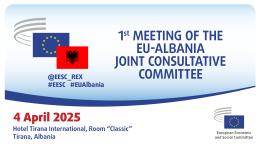
  • The first meeting of the EU-Albania Joint Consultative Committee (JCC) took place on 4 April 2025 in Tirana, Albania. This platform, established within the institutional framework of the EU-Albania Stabilisation and Association Agreement (SAA), will enable representatives from both the EU and Albanian civil society to monitor the country's accession negotiations, discuss issues of common interest, and highlight concerns to be addressed on Albanian's path towards the European Union.

  • Event type
    JCC Meeting

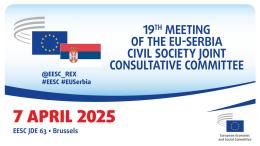
    The EU-Serbia Joint Consultative Committee (JCC) held its 19th meeting on 7 April 2025 at the EESC in Brussels. This platform, established within the institutional framework of the EU-Serbia Stabilisation and Association Agreement (SAA), will enable representatives from both the EU and Serbian civil society to monitor the country's accession negotiations, discuss issues of common interest, and highlight concerns to be addressed on Serbia's path towards the European Union.


  • Civil society for an open democratic debate
    Event type
    Conference

    This conference in Lisbon is the fourth event on disinformation being hosted by the European Economic and Social Committee (EESC) as part of its ongoing project aiming to fight disinformation with the help of civil society.

  • Towards a successful EU Enlargment

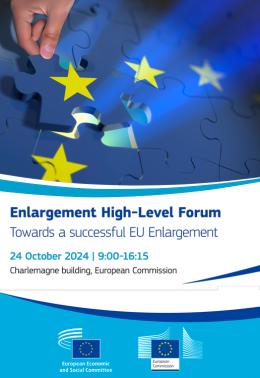
    On 24 th October, the EESC will welcome some 100 Enlargement Candidate Members (ECMs) in the Enlargement High-Level Forum "Towards  successful EU Enlargement" jointly organised with the European Commission back-to-back to Plenary. 

  • Civil society for an open democratic debate

    This is the 2nd campaign on fighting disinformation that the European Economic and Social Committee (EESC) is organising as part of its overall project on disinformation to be implemented with the help of civil society.

  • Connecting EU 2022
    -

    The EESC's annual seminar for civil society communicators zoomed in on the impact of the war in Ukraine on the EU, addressing three thorny issues.

  • Event type
    JCC Meeting

    For the 8th time, the European Economic and Social Committee (EESC) and Montenegro held the Civil Society Joint Consultative Committee (JCC) in Budva, Montenegro.

    This meeting tackled following issues: Assessment of the state of play in Montenegro accession negotiations to the EU, Chapter 28 of the accession negotiations – with focus on Consumer protection and Debate on the situation of young people on the labour market.

  • Event type
    JCC Meeting
  • Published in
    16 pages

    Europe is facing a pivotal moment. Social and economic inequalities, rapid technological change, anti-democratic forces and geopolitical instability are straining the foundations of the European project.

    With democracy and civic space under mounting pressure, civil society organisations, human rights defenders and free media face growing constraints - from restrictive laws and disinformation campaigns to underfunding and public distrust. Deepening polarisation and eroding trust in institutions further undermine Europe’s democratic model.