Enlargement countries

This page is also available in:

The EESC is actively engaged in the enlargement process of the EU and has developed a dual approach - regional and bilateral - for its relations with civil society organisations (CSOs) in the enlargement countries.

As far as the regional approach is concerned, the Western Balkans Follow-up Committee – a permanent internal body of the EESC – is the main instrument for coordinating the EESC's activities in this region. The Western Balkans Civil Society Forum, organised every two years, is part of the work of the Follow-up Committee.

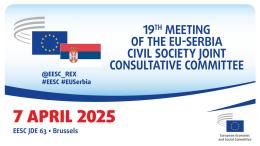
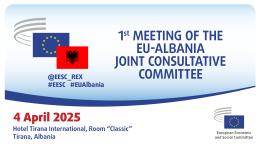
The EESC also works bilaterally with countries of the Western Balkans and Türkyie. On the basis of association agreements between these countries and the EU, in order to involve CSOs in the pre-accession and accession processes, the EESC has created three joint bodies with civil society representatives – with Türkyie, Montenegro and Serbia. Each body is composed of an equal number of members from the EESC and the partner country and meets twice a year.

The EESC keeps up regular contacts and organises joint activities with the CSOs of enlargement countries with whom no joint body of civil society representatives has yet been established.

The work of the joint bodies is complemented by the preparation of EESC opinions on the pre-accession and accession processes of individual countries, as well as on topics of regional interest.

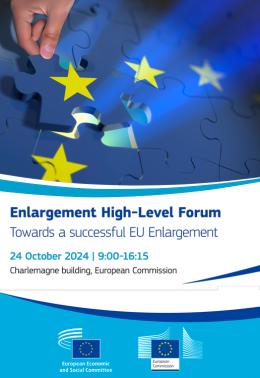
  • Towards a successful EU Enlargment

    On 24 th October, the EESC will welcome some 100 Enlargement Candidate Members (ECMs) in the Enlargement High-Level Forum "Towards  successful EU Enlargement" jointly organised with the European Commission back-to-back to Plenary. 

  • Civil society for an open democratic debate

    This is the 2nd campaign on fighting disinformation that the European Economic and Social Committee (EESC) is organising as part of its overall project on disinformation to be implemented with the help of civil society.

  • Connecting EU 2022
    -

    The EESC's annual seminar for civil society communicators zoomed in on the impact of the war in Ukraine on the EU, addressing three thorny issues.

  • Event type
    JCC Meeting

    For the 8th time, the European Economic and Social Committee (EESC) and Montenegro held the Civil Society Joint Consultative Committee (JCC) in Budva, Montenegro.

    This meeting tackled following issues: Assessment of the state of play in Montenegro accession negotiations to the EU, Chapter 28 of the accession negotiations – with focus on Consumer protection and Debate on the situation of young people on the labour market.

  • Event type
    JCC Meeting
  • Published in
    13 pages

    The European Economic and Social Committee (EESC) on 19 June 2025 adopted a resolution to provide the European Commission with a contribution to its 2026 work programme.

  • Published in
    8 pages

    2025 Civil Society Week conclusions

  • Published in
    8 pages

    This resolution presents recommendations of the European Economic and Social Committee to the legislature 2024-2029. They are based on discussions with social partners and civil society organizations from all walks of life, including young people during the first EESC Civil Society Week, and contain a comprehensive set of actionable steps to strengthen and safeguard democratic principles.

  • Published in
    15 pages

    This document seeks to provide input to the Global Coalition for Social Justice. It highlights key messages from EESC opinions on the six priority areas identified by the International Labour Organization (ILO) for immediate action.

  • Published in
    8 pages

    2024 Civil Society Week conclusions