Pays de l’élargissement

This page is also available in:

Le CESE participe activement au processus d’élargissement de l’Union et a défini une approche double - régionale et bilatérale - dans ses relations avec les organisations de la société civile dans les pays de l’élargissement.

En ce qui concerne l’approche régionale, le comité de suivi «Balkans occidentaux», un organe interne permanent du CESE, constitue le principal instrument pour la coordination des activités du CESE dans cette région. Le forum de la société civile des Balkans occidentaux, qui se tient tous les deux ans, fait partie du travail du comité de suivi.

Le CESE travaille aussi de façon bilatérale avec les pays des Balkans occidentaux et avec la Turquie. Sur la base des accords d’association conclus entre ces pays et l’Union, le CESE a créé, avec le Monténégro, la Serbie et la Turquie, trois organes conjoints incluant des représentants de la société civile afin d’associer les organisations de la société civile aux processus de préadhésion et d’adhésion. Chaque organe se compose d’un nombre identique de membres du CESE et du pays partenaire et se réunit deux fois par an.

Le CESE entretient des contacts réguliers et organise des activités conjointes avec les organisations de la société civile des pays de l’élargissement pour lesquels il n’existe pas encore d’organe conjoint des représentants de la société civile.

Le travail des organes conjoints est complété par la préparation d’avis du CESE sur les processus de préadhésion et d’adhésion de chacun des pays, ainsi que sur des thèmes d’intérêt régional.

  • Building an Inclusive Future in an Enlarged EU: The role of Social Dialogue, Civil Society and Youth Engagement

    As part of its ongoing Enlargement Candidate Members (ECMs) initiative, the EESC hosted a second Enlargement Forum on 17 July 2025 in Brussels. The event gathered ministers for European affairs from candidate countries, senior officials from the European Commission, social partners, and civil society representatives to discuss the role of civil and social dialogue in the EU enlargement process.

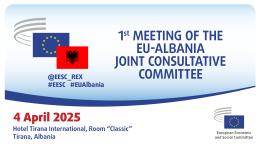
  • The first meeting of the EU-Albania Joint Consultative Committee (JCC) took place on 4 April 2025 in Tirana, Albania. This platform, established within the institutional framework of the EU-Albania Stabilisation and Association Agreement (SAA), will enable representatives from both the EU and Albanian civil society to monitor the country's accession negotiations, discuss issues of common interest, and highlight concerns to be addressed on Albanian's path towards the European Union.

  • Event type
    JCC Meeting

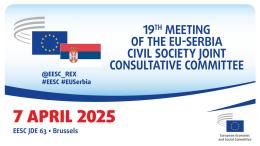
    The EU-Serbia Joint Consultative Committee (JCC) held its 19th meeting on 7 April 2025 at the EESC in Brussels. This platform, established within the institutional framework of the EU-Serbia Stabilisation and Association Agreement (SAA), will enable representatives from both the EU and Serbian civil society to monitor the country's accession negotiations, discuss issues of common interest, and highlight concerns to be addressed on Serbia's path towards the European Union.


  • Civil society for an open democratic debate
    Event type
    Conference

    This conference in Lisbon is the fourth event on disinformation being hosted by the European Economic and Social Committee (EESC) as part of its ongoing project aiming to fight disinformation with the help of civil society.

  • Towards a successful EU Enlargment

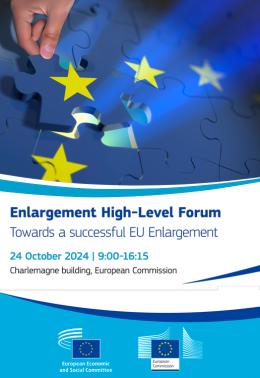
    On 24 th October, the EESC will welcome some 100 Enlargement Candidate Members (ECMs) in the Enlargement High-Level Forum "Towards  successful EU Enlargement" jointly organised with the European Commission back-to-back to Plenary. 

  • Civil society for an open democratic debate

    This is the 2nd campaign on fighting disinformation that the European Economic and Social Committee (EESC) is organising as part of its overall project on disinformation to be implemented with the help of civil society.

  • Geopolitical turmoil at Europe's door: the perspective of civil society
    -

    The EESC's annual seminar for civil society communicators will zoom in on the impact of the war in Ukraine on the EU, addressing three thorny issues: Energy, EU enlargement and Communication

  • Event type
    JCC Meeting

    Pour la 8e fois, le Comité économique et social européen (CESE) et le Monténégro tiendra le Comité de la société civile consultatif mixte (CCM) à Budva, au Monténégro. Le CCM est une plate-forme de la société civile établie entre le CESE et la société civile monténégrine. Il complète avec un point de la société civile de vue, le cadre institutionnel de l'UE relative à l'accord de stabilisation et d'association entre l'UE et le Monténégro. Cette institution conjointe permet aux organisations de la société civile des deux côtés pour surveiller les négociations d'adhésion du pays.

  • Event type
    JCC Meeting

    La 7e réunion du Comité Consultatif Mixte de la société civile UE-Monténégro se tiendra le 8 juillety au CESE à Bruxelles et abordera des questions telles que:

    • l’état d’avancement actuel dans les relations UE-Monténégro et du processus d’adhésion,
    • Le programme de connectivité dans les domaines de l’énergie et des transports
    • le chapitre 5 — Marchés publics
    •  l’état des relations industrielles et le développement des organisations de la société civile (OSC) au Monténégro
  • Published in
    16 pages

    Europe is facing a pivotal moment. Social and economic inequalities, rapid technological change, anti-democratic forces and geopolitical instability are straining the foundations of the European project.

    With democracy and civic space under mounting pressure, civil society organisations, human rights defenders and free media face growing constraints - from restrictive laws and disinformation campaigns to underfunding and public distrust. Deepening polarisation and eroding trust in institutions further undermine Europe’s democratic model.