Udvidelseslandene

This page is also available in:

EØSU deltager aktivt i EU-udvidelsesprocessen og har udviklet en tostrenget – regional og bilateral – strategi for forbindelserne til civilsamfundsorganisationerne i udvidelseslandene.

På det regionale plan er Opfølgningsudvalget for det vestlige Balkan, som er et permanent, internt EØSU-organ, det vigtigste instrument til koordinering af EØSU's aktiviteter i regionen. Opfølgningsudvalgets arbejde omfatter bl.a. møder i Civilsamfundsforummet for Vestbalkan, der afholdes hvert andet år.

EØSU arbejder desuden bilateralt med landene i det vestlige Balkan og Tyrkiet. EØSU har på baggrund af associeringsaftalerne mellem disse lande og EU skabt tre fælles organer med repræsentanter for civilsamfundet i Tyrkiet, Montenegro og Serbien. Formålet er at involvere civilsamfundsorganisationerne i førtiltrædelses- og tiltrædelsesprocessen. Hvert enkelt organ består af lige mange medlemmer fra EØSU og partnerlandene, og de mødes to gange om året.

EØSU har regelmæssig kontakt og arrangerer fælles aktiviteter med civilsamfundsorganisationerne i de udvidelseslande, hvormed der endnu ikke er oprettet noget fælles civilsamfundsorgan.

EØSU supplerer arbejdet i de blandede organer med udtalelser om førtiltrædelses- og tiltrædelsesprocessen i de enkelte lande samt emner af regional interesse.

  • Published in
    8 pages

    The External Relations Section (REX) of the European Economic and Social Committee (EESC) is responsible for dialogue between European civil society organisations and their homologues from the countries with which the European Union has formal relations (e.g. under the form of a Free Trade Agreement). Through this dialogue, made possible by a series of bilateral bodies, and through specialized opinions and information reports, the Committee is able to concretely contribute to EU foreign policy.

  • The  EU-Serbia Joint Consultative Committee (JCC) held its 14th meeting on 29 November 2022 in Belgrade, to discuss the state of play in the accession process and reform policies in the country. The participants from Serbia and the EU Institutions, as well as from civil society organisations pointed out concerns and challenges that still need further improvement. The joint declaration of the EU-Serbia JCC was adopted unanimously.

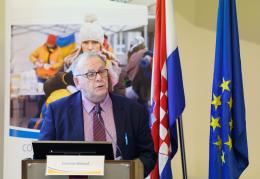
  • Panel I - In the shadow of war: Europe's new geopolitical context and the consequences for the future of the EU, Zagreb

  • Connecting EU 2022
    -

    The EESC's annual seminar for civil society communicators zoomed in on the impact of the war in Ukraine on the EU, addressing three thorny issues.

  • Reference number
    44/2022

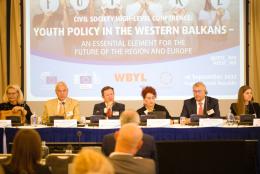
    The high-level civil society conference on youth policy in the Western Balkans, hosted by the European Economic and Social Committee (EESC), highlighted the key role of young people for the future of the region and called for their active involvement in policy-making. 

  • Cohesion policy is key to overcoming the COVID-19 crisis, to achieving climate neutrality by 2050 and to reducing disparities in Europe. Its most serious challenge for the foreseeable future, however, is the war in Ukraine, the EESC cautions in a recent opinion. Rapid action is needed to help refugees and ensure the country's European integration.

  • Reference number
    26/2022

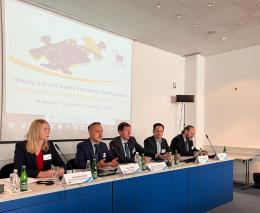
    On 24 May in Sarajevo, the EESC's Western Balkans Follow-up Committee held its yearly external meeting - for the first time since the COVID-19 pandemic - to meet with civil society organisations (CSOs) in Bosnia and Herzegovina and discuss their role and concerns regarding the current situation. The conclusions will be conveyed to the country's political authorities and to the EU institutions.


  • Reference number
    22/2022

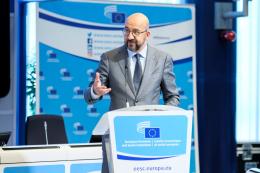
    The May plenary session of the European Economic and Social Committee (EESC) hosted a debate led by its President Christa Schweng and the President of the European Council Charles Michel on Europe's response to this turning point in history.

  • With youth as one of the main policy areas of the Innovation Agenda for the Western Balkans (WBs), the participants in the hearing "Youth Policy in the Western Balkans, as part of the Innovation Agenda for the WBs", held by the EESC, reaffirmed the importance of young people for the future of the region.

  • The 51st Western Balkans Follow-up Committee meeting, held on 3 December 2021, placed conflict resolution and normalisation of relations between Kosovo* and Serbia in the spotlight. The meeting, presided by Ionuţ Sibian, hosted prominent speakers from the ranks of EU officials, Western Balkans experts, as well as civil society representatives from the local communities, all of whom agreed that EU-facilitated dialogue was the only way to move forward.