European Economic
and Social Committee
European Economic
and Social Committee
The European Economic and Social Committee (EESC) is the voice of organised civil society in Europe.
Find out more about its role and structure at http://www.eesc.europa.eu/en/about
The EESC issues between 160 and 190 opinions, evaluation and information reports a year.
It also organises several annual initiatives and events with a focus on civil society and citizens’ participation such as the Civil Society Prize, the Civil Society Days, the Your Europe, Your Say youth plenary and the ECI Day.
Find the latest EESC opinions and publications at http://www.eesc.europa.eu/en/our-work/opinions-information-reports/opinions and http://www.eesc.europa.eu/en/our-work/publications-other-work/publications respectively.
The EESC is active in a wide range of areas, from social affairs to economy, energy and sustainability.
Learn more about our policy areas and policy highlights at http://www.eesc.europa.eu/en/policies
The EESC holds nine plenary sessions per year. It also organises many conferences, public hearings and high-level debates related to its work.
Find out more about our upcoming events at http://www.eesc.europa.eu/en/agenda/our-events/upcoming-events
Here you can find news and information about the EESC'swork, including its social media accounts, the EESC Info newsletter, photo galleries and videos.
Read the latest EESC news http://www.eesc.europa.eu/en/news-media/news and press releases http://www.eesc.europa.eu/en/news-media/press-releases
The EESC brings together representatives from all areas of organised civil society, who give their independent advice on EU policies and legislation. The EESC's326 Members are organised into three groups: Employers, Workers and Various Interests.
Find out more about our Members and groups at http://www.eesc.europa.eu/en/members-groups
The EESC has six sections, specialising in concrete topics of relevance to the citizens of the European Union, ranging from social to economic affairs, energy, environment, external relations or the internal market.
Find out more at http://www.eesc.europa.eu/en/sections-other-bodies
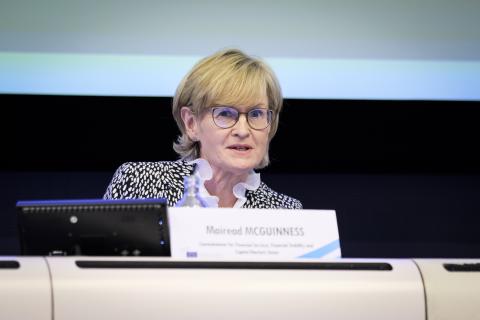
Het Europees Economisch en Sociaal Comité heeft tijdens zijn laatste zitting een debat gevoerd met Europees commissaris McGuinness over de vraag hoe een groener, duurzamer en meer gedigitaliseerd Europees economisch en financieel systeem tot stand kan worden gebracht.
Ook werd een aantal adviezen goedgekeurd die moeten helpen om de weg vrij te maken voor een echt duurzamere EU. In een initiatiefadvies stelt het EESC voor een reeks nieuwe indicatoren te ontwikkelen als aanvulling op het bbp en om de transitie te vergemakkelijken. In een ander advies onderschrijft het EESC de doelstelling om investeringen te heroriënteren, maar wijst het erop dat veel van de maatregelen die de Commissie in haar vernieuwde strategie voor duurzame financiering voorstelt, te aarzelend zijn en voorbijgaan aan het cruciale concept van sociale duurzaamheid. Bovendien wordt in de EU-taxonomie niet in gelijke mate rekening gehouden met milieu- en sociale doelstellingen en is er onduidelijkheid over controversiële economische activiteiten. In een derde advies ten slotte toont het EESC zich ingenomen met het idee van een nieuwe vrijwillige Europese norm voor groene obligaties en doet het belangrijke aanbevelingen om van deze norm een echt krachtig instrument te maken om investeerders te helpen investeren in projecten met een positieve impact op het milieu. (tk)