European Economic
and Social Committee
European Economic
and Social Committee
The European Economic and Social Committee (EESC) is the voice of organised civil society in Europe.
Find out more about its role and structure at http://www.eesc.europa.eu/en/about
The EESC issues between 160 and 190 opinions, evaluation and information reports a year.
It also organises several annual initiatives and events with a focus on civil society and citizens’ participation such as the Civil Society Prize, the Civil Society Days, the Your Europe, Your Say youth plenary and the ECI Day.
Find the latest EESC opinions and publications at http://www.eesc.europa.eu/en/our-work/opinions-information-reports/opinions and http://www.eesc.europa.eu/en/our-work/publications-other-work/publications respectively.
The EESC is active in a wide range of areas, from social affairs to economy, energy and sustainability.
Learn more about our policy areas and policy highlights at http://www.eesc.europa.eu/en/policies
The EESC holds nine plenary sessions per year. It also organises many conferences, public hearings and high-level debates related to its work.
Find out more about our upcoming events at http://www.eesc.europa.eu/en/agenda/our-events/upcoming-events
Here you can find news and information about the EESC'swork, including its social media accounts, the EESC Info newsletter, photo galleries and videos.
Read the latest EESC news http://www.eesc.europa.eu/en/news-media/news and press releases http://www.eesc.europa.eu/en/news-media/press-releases
The EESC brings together representatives from all areas of organised civil society, who give their independent advice on EU policies and legislation. The EESC's326 Members are organised into three groups: Employers, Workers and Various Interests.
Find out more about our Members and groups at http://www.eesc.europa.eu/en/members-groups
The EESC has six sections, specialising in concrete topics of relevance to the citizens of the European Union, ranging from social to economic affairs, energy, environment, external relations or the internal market.
Find out more at http://www.eesc.europa.eu/en/sections-other-bodies
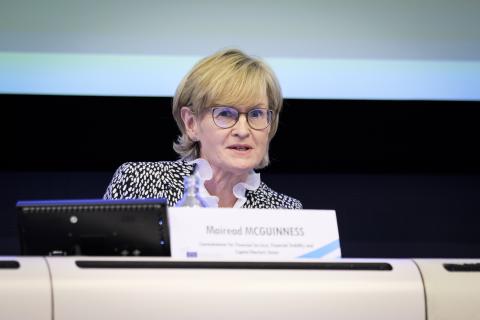
Auf seiner jüngsten Plenartagung debattierte der Europäische Wirtschafts- und Sozialausschuss mit EU-Kommissarin McGuinness über die Frage, wie sich ein grüneres, nachhaltigeres und stärker digitalisiertes Wirtschafts- und Finanzsystem in Europa bewerkstelligen lässt.
Auf der Plenartagung wurden mehrere Stellungnahmen verabschiedet, die dazu beitragen sollen, den Weg für eine wirklich nachhaltigere EU zu ebnen. In einer Initiativstellungnahme schlägt der EWSA die Ausarbeitung neuer Indikatoren vor, um das BIP zu ergänzen und den Übergang zu erleichtern. In einer anderen unterstützt er das Ziel, Investitionen umzulenken. Er ist allerdings auch der Ansicht, dass viele der von der Kommission in ihrer neuen Strategie für ein nachhaltiges Finanzwesen vorgeschlagenen Maßnahmen oft zu zögerlich sind und das maßgebliche Konzept der sozialen Nachhaltigkeit außer Acht lassen. Darüber hinaus werden in der EU-Taxonomie ökologische und soziale Ziele nicht in gleichem Maße erfasst, und es bestehen Zweifel bezüglich der Behandlung umstrittener Wirtschaftstätigkeiten. In einer dritten Stellungnahmen begrüßt der EWSA die Idee eines neuen freiwilligen EU-Standards für grüne Anleihen. Er spricht überdies wichtige Empfehlungen aus, wie dieser Standard maßgeblich dazu beitragen kann, Anleger zu Investitionen in umweltfreundliche Projekte zu bewegen. (tk)