European Economic
and Social Committee
European Economic
and Social Committee
The European Economic and Social Committee (EESC) is the voice of organised civil society in Europe.
Find out more about its role and structure at http://www.eesc.europa.eu/en/about
The EESC issues between 160 and 190 opinions, evaluation and information reports a year.
It also organises several annual initiatives and events with a focus on civil society and citizens’ participation such as the Civil Society Prize, the Civil Society Days, the Your Europe, Your Say youth plenary and the ECI Day.
Find the latest EESC opinions and publications at http://www.eesc.europa.eu/en/our-work/opinions-information-reports/opinions and http://www.eesc.europa.eu/en/our-work/publications-other-work/publications respectively.
The EESC is active in a wide range of areas, from social affairs to economy, energy and sustainability.
Learn more about our policy areas and policy highlights at http://www.eesc.europa.eu/en/policies
The EESC holds nine plenary sessions per year. It also organises many conferences, public hearings and high-level debates related to its work.
Find out more about our upcoming events at http://www.eesc.europa.eu/en/agenda/our-events/upcoming-events
Here you can find news and information about the EESC'swork, including its social media accounts, the EESC Info newsletter, photo galleries and videos.
Read the latest EESC news http://www.eesc.europa.eu/en/news-media/news and press releases http://www.eesc.europa.eu/en/news-media/press-releases
The EESC brings together representatives from all areas of organised civil society, who give their independent advice on EU policies and legislation. The EESC's326 Members are organised into three groups: Employers, Workers and Various Interests.
Find out more about our Members and groups at http://www.eesc.europa.eu/en/members-groups
The EESC has six sections, specialising in concrete topics of relevance to the citizens of the European Union, ranging from social to economic affairs, energy, environment, external relations or the internal market.
Find out more at http://www.eesc.europa.eu/en/sections-other-bodies
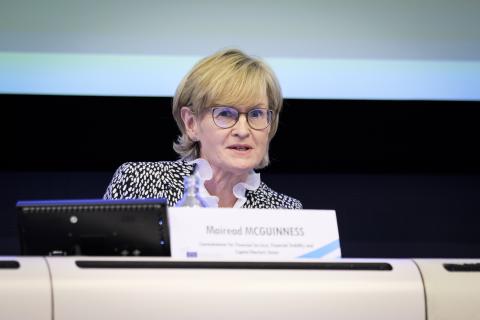
Ag an seisiún iomlánach deireanach a bhí aige, bhí díospóireacht ag Coiste Eacnamaíoch agus Sóisialta na hEorpa leis an gCoimisinéir Eorpach McGuinness faoi conas córas eacnamaíoch agus airgeadais níos glaise, níos inbhuanaithe agus níos digitithe a bhaint amach.
Le linn an tseisiúin iomlánaigh, glacadh roinnt tuairimí mar iarracht chun bealach i bhfad níos inbhuanaithe a réiteach san Aontas Eorpach. I dtuairim féintionscnaimh amháin, molann CESE go bhforbrófaí sraith táscairí nua chun OTI a chomhlánú agus chun cuidiú leis an aistriú sin. I dtuairim eile, cuireann CESE in iúl go dtacaíonn sé leis an sprioc maidir le hinfheistíochtaí a atreorú, ach go measann sé go bhfuil cuma ró-éiginnte ar chuid mhaith de na bearta atá molta ag an gCoimisiún ina straitéis airgeadais inbhuanaithe athnuaite agus go ndéantar neamhshuim de choincheap criticiúil na hinbhuanaitheachta sóisialta. Ina theannta sin, ní chuimsítear le tacsanomaíocht AE spriocanna comhshaoil agus sóisialta ar bhealach comhionann agus ardaítear ceisteanna léi faoi ghníomhaíochtaí eacnamaíocha conspóideacha. Ar deireadh, cuireann CESE in iúl sa tríú tuairim, gur díol sásaimh dó an smaoineamh maidir le Caighdeán nua deonach um Bannaí Glasa Eorpacha agus déanann sé moltaí criticiúla maidir le conas an caighdeán sin a iompú ina ionstraim fhíorchumhachtach chun cabhrú le hinfheisteoirí a dhíriú i dtreo infheistíochtaí i dtionscadail a bhfuil tionchar dearfach acu ar an gcomhshaol. (tk)