
European Economic
and Social Committee
European Economic
and Social Committee
The European Economic and Social Committee (EESC) is the voice of organised civil society in Europe.
Find out more about its role and structure at http://www.eesc.europa.eu/en/about
The EESC issues between 160 and 190 opinions, evaluation and information reports a year.
It also organises several annual initiatives and events with a focus on civil society and citizens’ participation such as the Civil Society Prize, the Civil Society Days, the Your Europe, Your Say youth plenary and the ECI Day.
Find the latest EESC opinions and publications at http://www.eesc.europa.eu/en/our-work/opinions-information-reports/opinions and http://www.eesc.europa.eu/en/our-work/publications-other-work/publications respectively.
The EESC is active in a wide range of areas, from social affairs to economy, energy and sustainability.
Learn more about our policy areas and policy highlights at http://www.eesc.europa.eu/en/policies
The EESC holds nine plenary sessions per year. It also organises many conferences, public hearings and high-level debates related to its work.
Find out more about our upcoming events at http://www.eesc.europa.eu/en/agenda/our-events/upcoming-events
Here you can find news and information about the EESC'swork, including its social media accounts, the EESC Info newsletter, photo galleries and videos.
Read the latest EESC news http://www.eesc.europa.eu/en/news-media/news and press releases http://www.eesc.europa.eu/en/news-media/press-releases
The EESC brings together representatives from all areas of organised civil society, who give their independent advice on EU policies and legislation. The EESC's326 Members are organised into three groups: Employers, Workers and Various Interests.
Find out more about our Members and groups at http://www.eesc.europa.eu/en/members-groups
The EESC has six sections, specialising in concrete topics of relevance to the citizens of the European Union, ranging from social to economic affairs, energy, environment, external relations or the internal market.
Find out more at http://www.eesc.europa.eu/en/sections-other-bodies
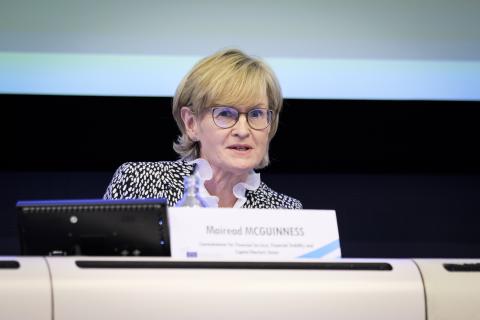
Lors de sa dernière session plénière, le Comité économique et social européen a tenu un débat avec M. McGuinness, commissaire européen, sur la manière de parvenir à un système économique et financier européen plus vert, plus durable et plus numérisé.
Plusieurs avis ont été adoptés en plénière, dans le but de contribuer à ouvrir la voie à une UE véritablement plus durable. Dans un avis d’initiative, le CESE propose d’élaborer une série de nouveaux indicateurs pour compléter celui du PIB et contribuer à la transition. Si le CESE, dans un autre avis, soutient l’objectif de réorientation des investissements, il estime cependant qu’une grande partie des mesures proposées par la Commission européenne dans sa stratégie renouvelée en matière de finance durable semblent souvent trop hésitantes et méconnaissent le concept essentiel de durabilité sociale. Par ailleurs, la taxinomie de l’UE n’intègre pas les objectifs environnementaux et sociaux sur un pied d’égalité et laisse planer des doutes sur certaines activités économiques controversées. Enfin, dans un troisième avis, le CESE se félicite de l’idée d’une nouvelle norme européenne en matière d’obligations vertes d’application volontaire et formule des recommandations essentielles sur la manière de transformer cette norme en un instrument véritablement puissant afin d’aider à orienter les investisseurs vers des investissements dans des projets ayant une incidence positive sur l’environnement. (tk)